Practical chemistry for exams›CP 6 - Chlorination of 2-methylpropan-2-ol with concentrated hydrochloric acid

CP 6 - Chlorination of 2-methylpropan-2-ol with concentrated hydrochloric acid

An overview of CP 6 - Chlorination of 2-methylpropan-2-ol with concentrated hydrochloric acid
2 min

In Edexcel Core Practical 6: Chlorination of 2-methylpropan-2-ol with concentrated hydrochloric acid, a reaction to form 2-chloro-2-methylpropane is carried out.

The crude product is separated, washed, and dried to isolate the chloroalkane, with the presence of chlorine confirmed using tests such as the addition of aqueous silver nitrate.

Add to favourites

In Edexcel core practical 6: Investigating chlorination of 2-methylpropan-2-ol, there are several important safety requirements to be aware of (beyond normal lab practice such as wearing goggles).

  • 2-methylpropan-2-ol and 2-chloro-2-methylpropane are both flammable – avoid naked flames.
  • Calcium chloride is an irritant.
  • Concentrated hydrochloric acid is corrosive and the fumes it produces are toxic and corrosive – carry out this practical in a fume cupboard or well-ventilated room.

Add to favourites
The image presents a step-by-step experimental method titled 'Edexcel Core Practical 6.' It consists of seven numbered steps with corresponding illustrations. 

Step 1: Shows a large conical flask with labels '10 cm³ of 2-methylpropan-2-ol' and '25 cm³ of concentrated hydrochloric acid' being added. It instructs to measure and mix these in a large conical flask and gently swirl until a clear solution forms. 

Step 2: Illustrates a large conical flask with '20 cm³ of crude product,' showing swirling action. It instructs to swirl gently for 20 minutes, allowing the product to form and separate into two layers. 

Step 3: Depicts a separating funnel with two layers labeled 'top aqueous layer' and 'bottom organic chloride,' instructing to pour the mixture into the funnel and shake gently. 

Step 4: Shows the separating funnel with layers labeled 'aqueous layer' and 'organic layer,' instructing to drain the lower aqueous layer and retain the upper organic layer. 

Step 5: Illustrates the addition of '20 cm³ of sodium hydrogen carbonate solution,' instructing to swirl, vent frequently, and discard the aqueous layer. 

Step 6: Shows 'Anhydrous sodium sulfate' being added to a small conical flask containing the 'organic layer,' instructing to swirl until clear. 

Step 7: Depicts a condenser setup with labels 'Thermometer' and 'Water in/out,' instructing to pour the dried organic liquid into a distillation apparatus and collect the fraction boiling between 50-52°C.
Add to favourites

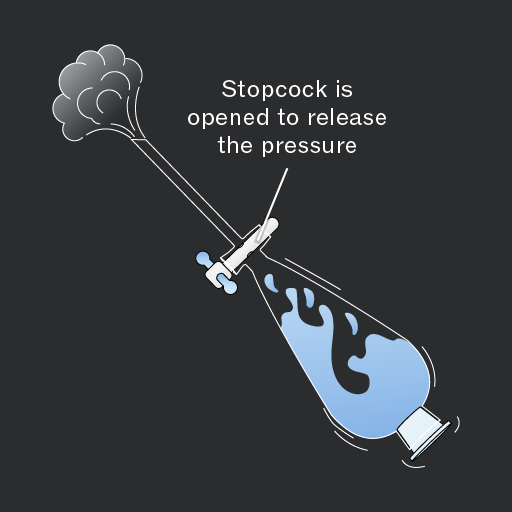
Vapour can be produced when volatile substances are mixed in a separating funnel.
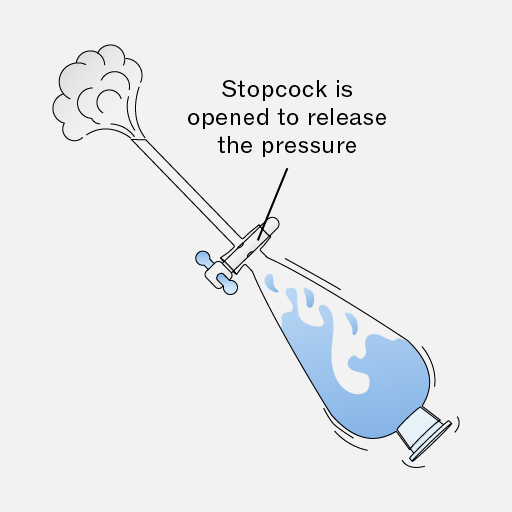
A laboratory setup showing a stopcock that is opened to release the pressure, with steam coming out and a flask containing a blue liquid.
Do

Vent the separating funnel periodically. This allows the release of any gas produced.

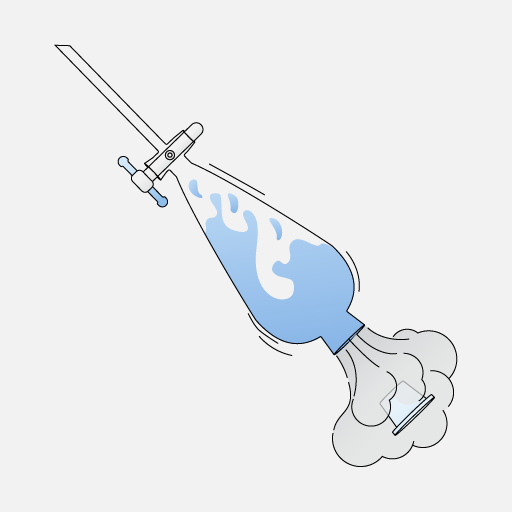
A laboratory apparatus with a blue liquid and steam coming out of a flask, held by a clamp.
Don't

Shake the separating funnel with the stopper in place without venting – pressure can build up and cause the stopper to fly off.

Add to favourites

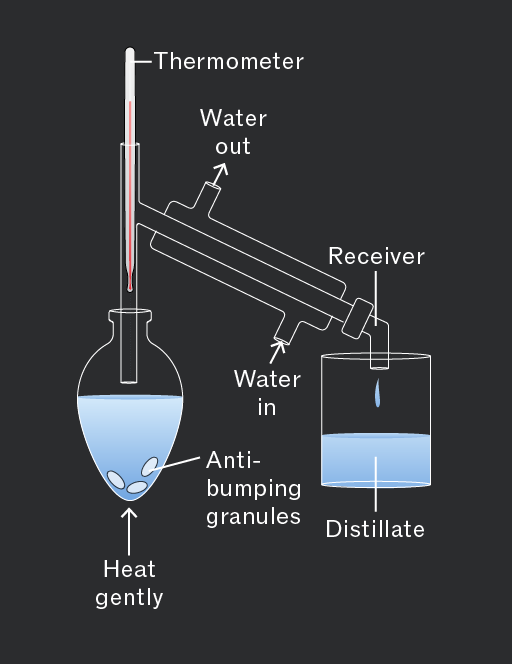
The distillation process requires careful setup to avoid loss of product or accidents.
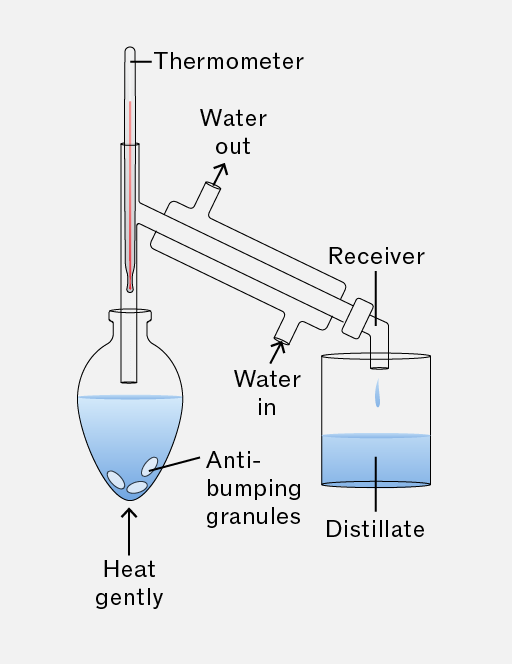
An illustration of a distillation apparatus showing a thermometer, water out, receiver, water in, anti-bumping granules, and distillate. The flask is labeled to heat gently.
Do

Use anti-bumping granules and heat the mixture gently during distillation.

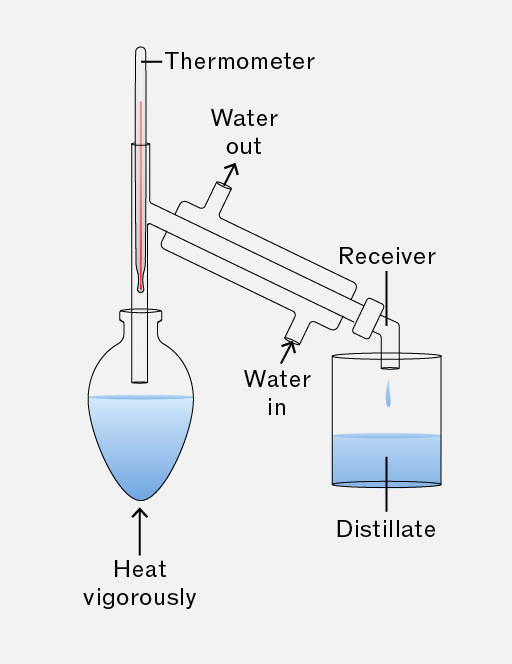
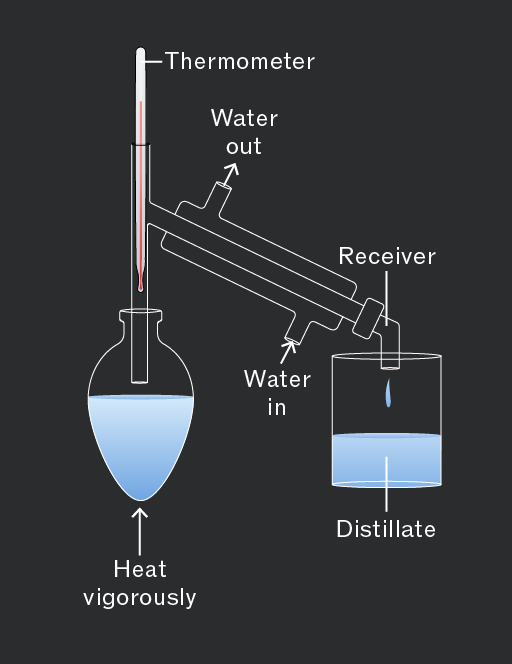
A diagram illustrating a distillation setup. It includes a thermometer, a flask labeled 'Heat vigorously', a receiver, and arrows indicating 'Water in' and 'Water out'. The flask contains blue liquid, and the receiver is labeled 'Distillate'.
Don't

Allow the mixture to boil violently or heat it without anti-bumping granules – this can cause dangerous splashing or bumping.

Add to favourites

Further tests can be done on the distillate to confirm the presence of 2-chloro-2-methylpropane.

After adding 5 cm3 of ethanol, 1 cm3 of aqueous sodium hydroxide, and warming the mixture in a water bath, a hydrolysis reaction occurs, releasing the chloride ions.
Adding excess nitric acid and a few drops of silver nitrate solution, a precipitate of silver chloride will form if the chloroalkane is present. The silver chloride precipitate appears as a white solid.

Add to favourites