Practical chemistry for exams›CP 15 - Analysis of some inorganic and organic unknowns

CP 15 - Analysis of some inorganic and organic unknowns

An overview of CP 15 - Analysis of some inorganic and organic unknowns
3 min

In Core Practical 15: Analysis of some inorganic and organic unknowns, substances are analysed to identify their composition. The aim of the practical is to apply a range of chemical tests and analytical techniques to determine the identity of unknown organic and inorganic compounds.

Add to favourites

In Edexcel core practical 15: Analyse organic and inorganic unknowns, there are several important safety requirements to be aware of (beyond normal lab practice such as wearing goggles).

  • Concentrated hydrochloric acid, sodium hydroxide, and concentrated sulfuric acid are corrosive.
  • Nitric acid, hydrochloric acid, and limewater are irritants.
  • Barium chloride and bromine water are toxic and irritants.
  • Ethanol is flammable – avoid naked flames.
  • Pay close attention to the hazard warnings on the tubs and bottles of unknown substances.
Add to favourites
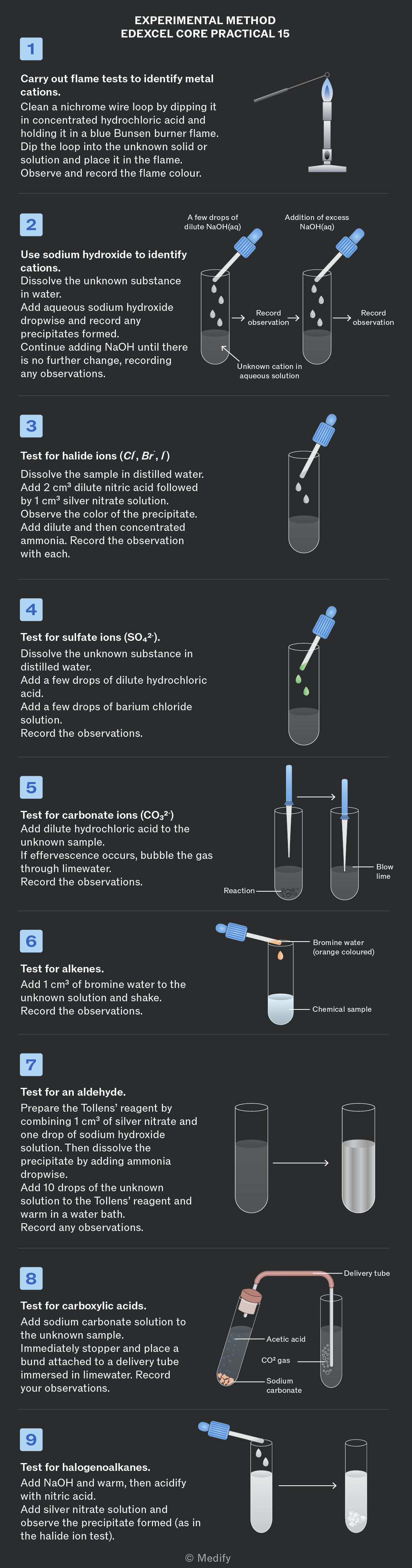
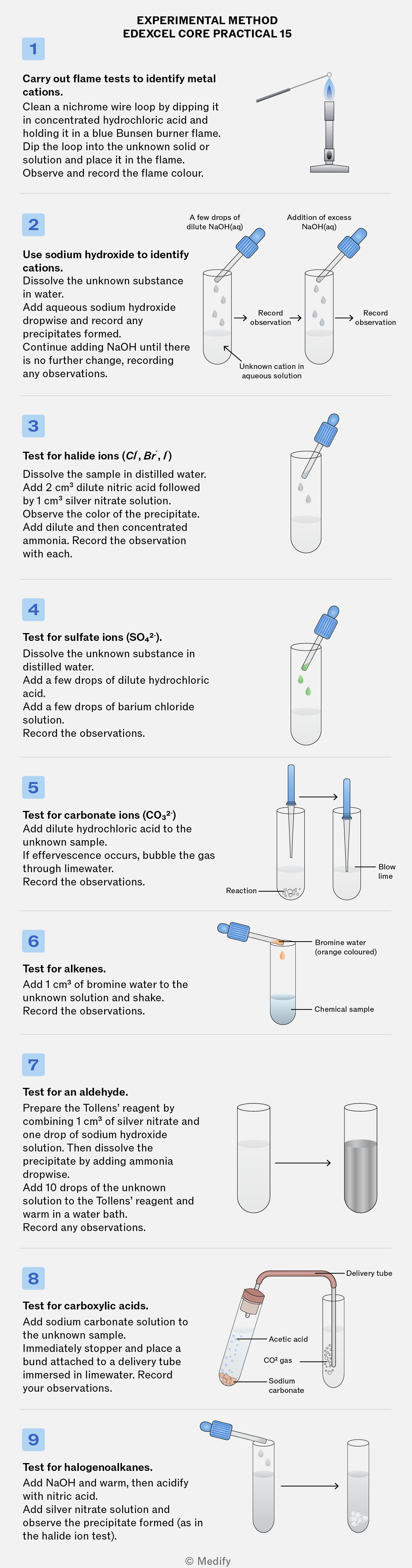
A series of steps for Edexcel Core Practical 15 to identify various ions and compounds. Step 1: Carry out flame tests to identify metal cations. Use a nichrome wire loop dipped in concentrated hydrochloric acid, place it in a blue Bunsen burner flame, and observe the flame color. Step 2: Use sodium hydroxide to identify cations. Add a few drops of NaOH(aq) to the unknown solution and record observations. Continue adding excess NaOH(aq) and record any changes. Step 3: Test for halide ions (Cl⁻, Br⁻, I⁻) by adding dilute nitric acid and silver nitrate to the sample and observe precipitate color. Add ammonia and record observations. Step 4: Test for sulfate ions (SO₄²⁻) by adding dilute hydrochloric acid and barium chloride to the solution. Record observations. Step 5: Test for carbonate ions (CO₃²⁻) by adding dilute hydrochloric acid, observing effervescence, and bubbling gas through limewater. Step 6: Test for alkenes by adding bromine water to the sample, shaking, and recording observations. Step 7: Test for an aldehyde using Tollens' reagent. Combine silver nitrate and sodium hydroxide, dissolve precipitate with ammonia, add unknown solution, and warm in a water bath. Record observations. Step 8: Test for carboxylic acids by adding sodium carbonate, using a delivery tube in limewater, and recording observations. Step 9: Test for halogenoalkanes by adding NaOH, warming, acidifying with nitric acid, and adding silver nitrate to observe precipitate formation.
Add to favourites

Wearing the appropriate personal protective equipment is essential to avoid direct contact with harmful chemicals and to ensure safety throughout the experiment.
A simple illustration of a pair of goggles and gloves.
Do

Wear goggles and gloves when handling any chemicals, particularly concentrated acids, ammonia, and metal salts, as they can be corrosive or irritating to the skin and eyes.

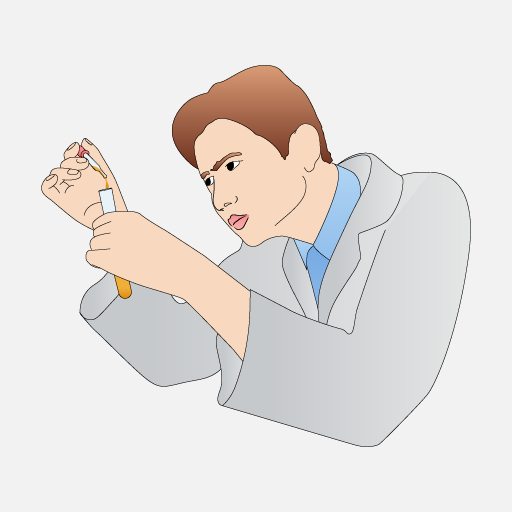
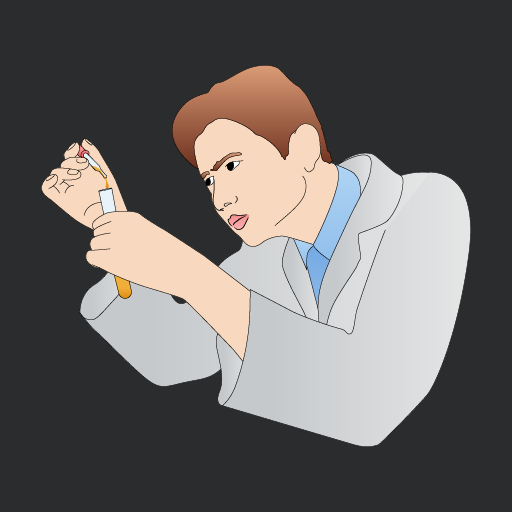
A person wearing no goggles or gloves whilst handling chemicals.
Don't

Skip protective equipment just because ‘it’s only a few drops’.

Add to favourites

It is crucial to use clean and dry glassware when performing analytical tests.
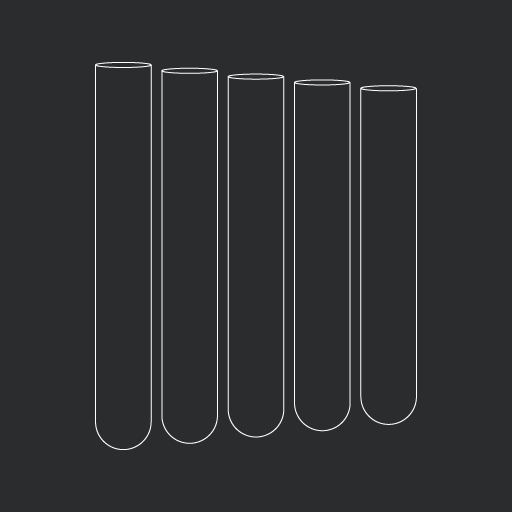
Five test tubes arranged in a row, with varying heights and shapes.
Do

Ensure all glassware is clean and dry before use to avoid contamination and ensure accurate results.

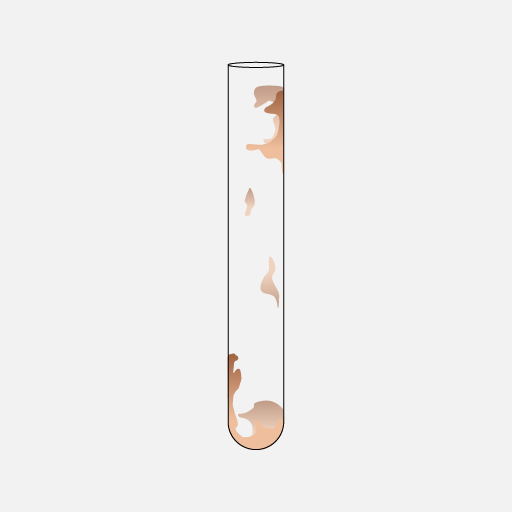
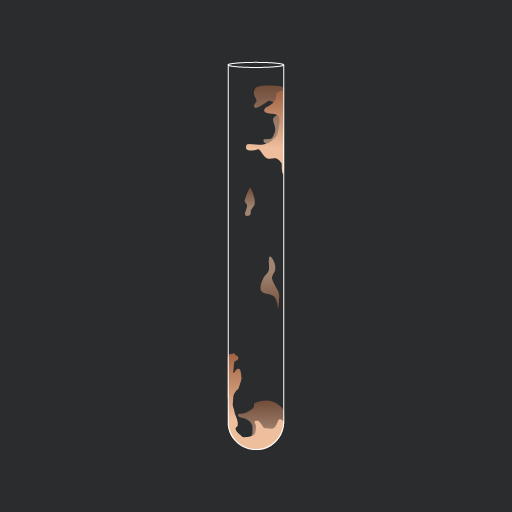
A test tube with a white body and brownish stains or markings on its surface.
Don't

Reuse glassware that has not been properly cleaned and dried, as this could lead to inaccurate readings or unintended chemical reactions.

Add to favourites

Proper disposal of chemicals is essential to avoid environmental damage and ensure safe laboratory practices. Always follow disposal guidelines.
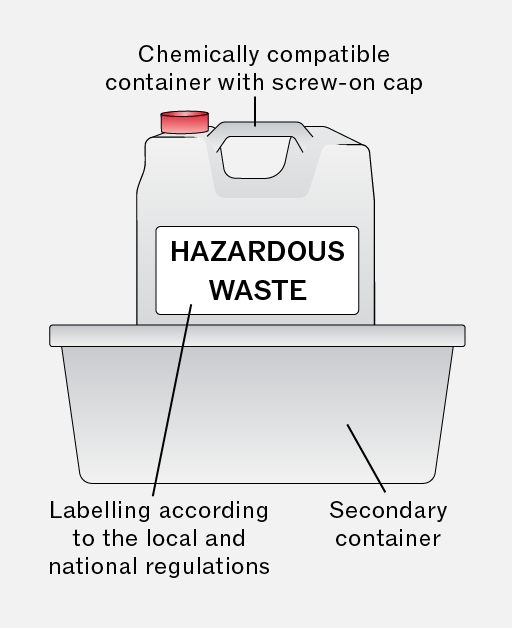
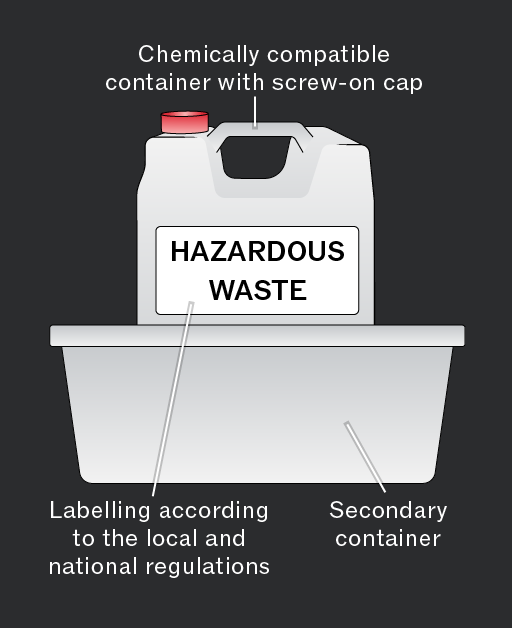
A diagram showing a chemically compatible container with screw-on cap labeled 'HAZARDOUS WASTE' placed inside a secondary container. There are labels indicating 'Labelling according to the local and national regulations'.
Do

Dispose of chemicals safely after testing by placing them in the designated waste containers. Always follow your teacher’s instructions for disposal.

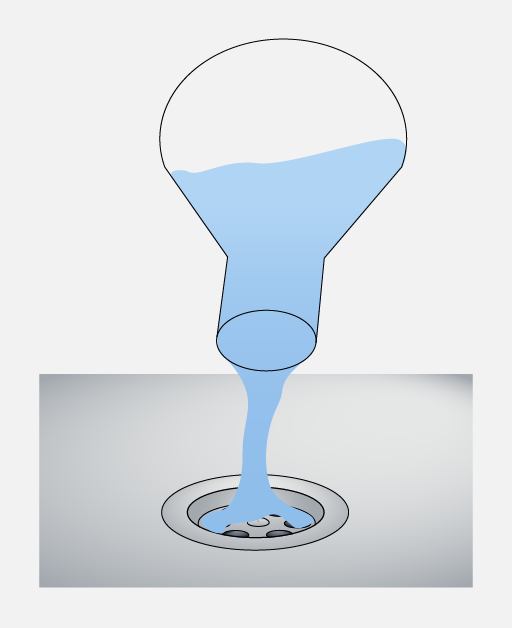
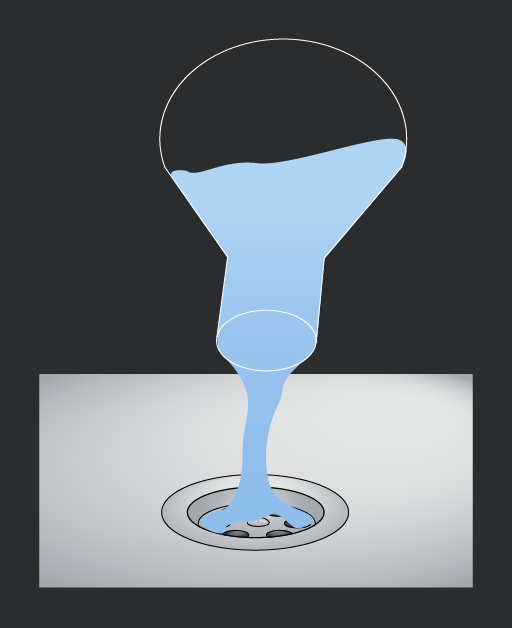
A funnel pouring blue liquid into a drain.
Don't

Pour chemicals down the drain unless specifically directed to do so, as some chemicals may cause harmful reactions in the plumbing or be harmful to aquatic organisms.

Add to favourites

Testing for aldehydes and ketones: With the addition of Tollens’ reagent, a silver mirror forms on the test tube in the presence of aldehydes. The addition of Fehling’s solution produces a brick red precipitate in the presence of aldehyde.
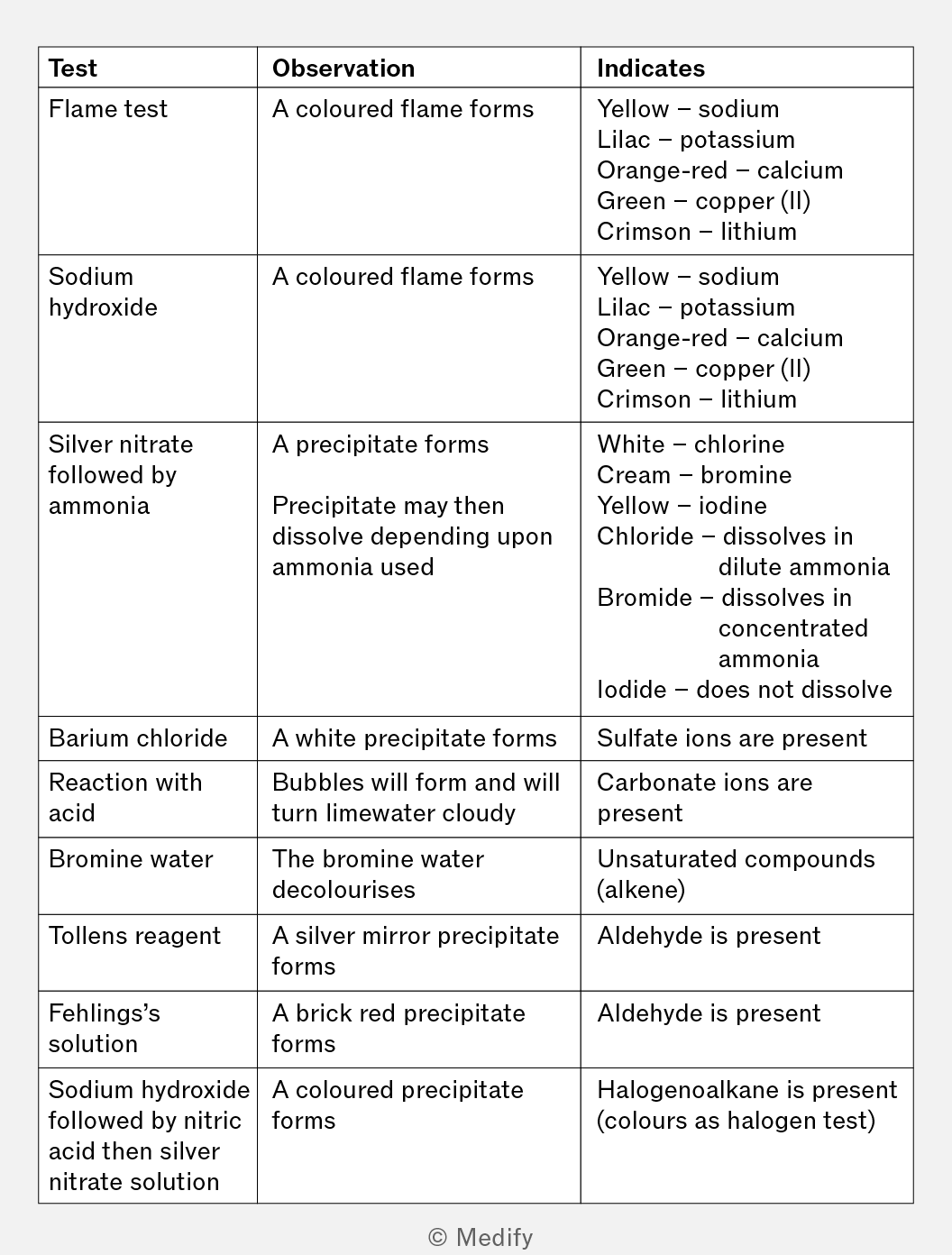
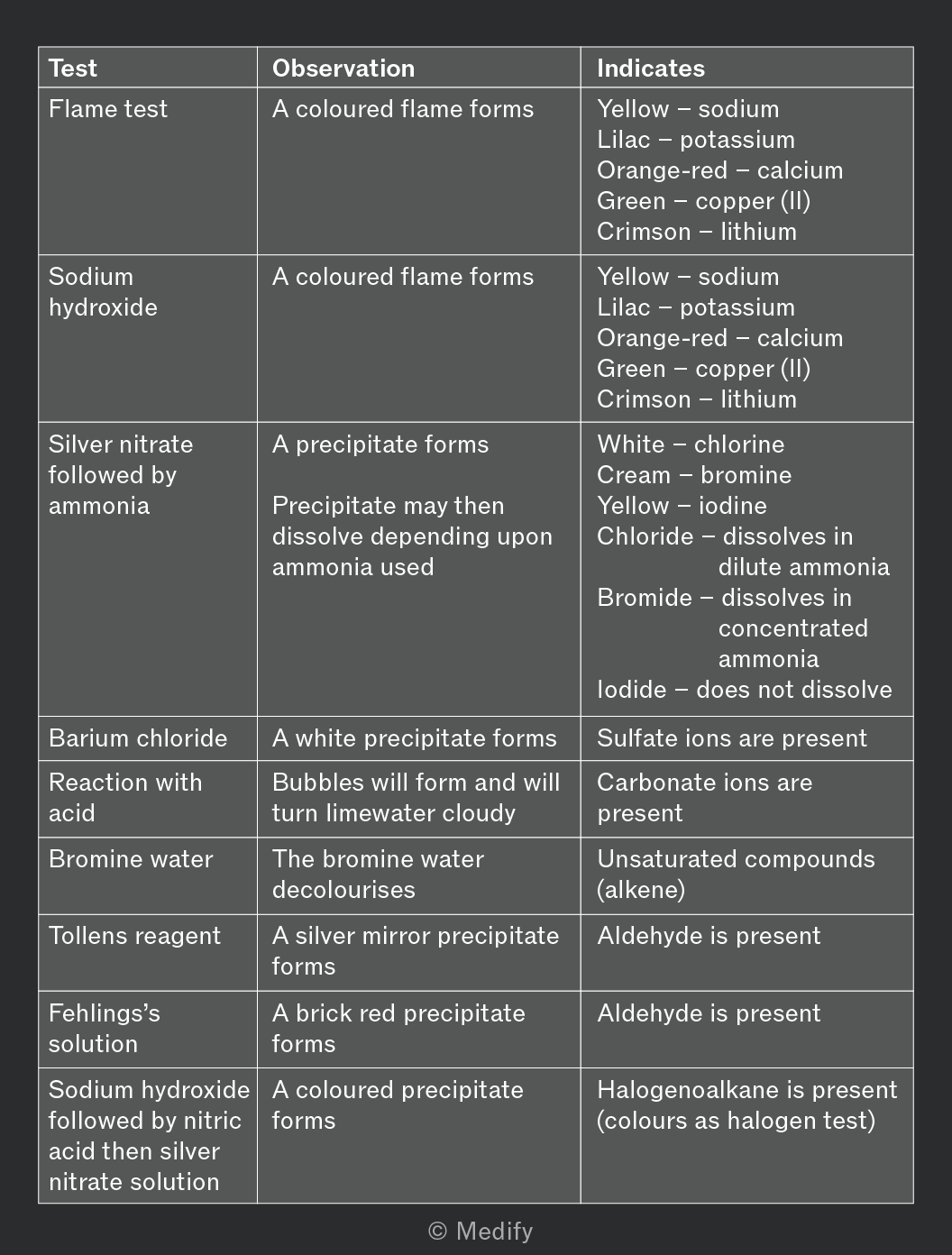
A table with three columns labeled 'Test', 'Observation', and 'Indicates'. Under 'Test': Flame test, Sodium hydroxide, Silver nitrate followed by ammonia, Barium chloride, Reaction with acid, Bromine water, Tollens reagent, Fehling’s solution, Sodium hydroxide followed by nitric acid then silver nitrate solution. Under 'Observation', corresponding to each test: 'A coloured flame forms', 'A coloured flame forms', 'A precipitate forms; Precipitate may then dissolve depending upon ammonia used', 'A white precipitate forms', 'Bubbles will form and will turn limewater cloudy', 'The bromine water decolourises', 'A silver mirror precipitate forms', 'A brick red precipitate forms', 'A coloured precipitate forms'. Under 'Indicates', corresponding to each observation: 'Yellow – sodium; Lilac – potassium; Orange-red – calcium; Green – copper (II); Crimson – lithium', 'Yellow – sodium; Lilac – potassium; Orange-red – calcium; Green – copper (II); Crimson – lithium', 'White – chlorine; Cream – bromine; Yellow – iodine; Chloride – dissolves in dilute ammonia; Bromide – dissolves in concentrated ammonia; Iodide – does not dissolve', 'Sulfate ions are present', 'Carbonate ions are present', 'Unsaturated compounds (alkene)', 'Aldehyde is present', 'Aldehyde is present', 'Halogenoalkane is present (colours as halogen test)'.
Add to favourites