
CP 10 - Investigating some electrochemical cells
On this page
In Edexcel Core Practical 10: Investigating some electrochemical cells, the electrode potentials of different metal/metal ion half-cells are determined to understand how electrochemical cells generate voltage.
This experiment allows you to determine the tendency of metals to lose or gain electrons, helping to understand redox reactions and the electrochemical series.
In Edexcel core practical 10: Construct electrochemical cells and measure electrode potentials, there are several important safety requirements to be aware of (beyond normal lab practice such as wearing goggles).
- Zinc sulfate and 1.0 mol dm−3 iron(II) sulfate are harmful.
- Potassium nitrate is oxidising.
![The image illustrates the experimental method for Edexcel Core Practical 10, divided into six main steps. 1. Prepare the metal strips: A hand is shown using sandpaper to clean zinc and copper strips. 2. Set up the half cells: Diagrams show a zinc strip in a beaker of zinc sulfate solution labeled 'Zn foil electrode' and 'Zinc sulfate solution' with the reaction Zn²⁺ + 2e⁻ ↔ Zn. Another beaker contains a copper strip in copper (II) sulfate solution labeled 'Cu foil electrode' and 'Copper (II) sulfate solution' with the reaction Cu²⁺ + 2e⁻ ↔ Cu. 3. Set up the electrochemical cell: A strip of filter paper soaked in saturated potassium nitrate solution acts as a salt bridge between the two beakers. The zinc and copper strips are connected to a voltmeter using connecting wires and crocodile clips, labeled 'Zn', 'Cu', 'ZnSO₄', 'CuSO₄', and 'Salt bridge'. 4. Record the electrode potential: An image of a voltmeter displaying '5.00'. 5. Repeat the experiment: Shows a voltmeter with '0.00' and suggests repeating with combinations [Zn(s) | Zn²⁺(aq)] and [Fe²⁺(aq) | Fe(s)], [Fe(s) | Fe²⁺(aq)] and [Cu²⁺(aq) | Cu(s)], [Zn(s) | Zn²⁺(aq)] and [Ag⁺(aq) | Ag(s)], [Cu(s) | Cu²⁺(aq)] and [Ag⁺(aq) | Ag(s)], with a reminder to clean metal strips before each test. 6. Record results: A table is shown with columns for 'Half cell 1 (oxidation)', 'E* (V)', and 'Half cell 2 (reduction)' showing various combinations such as [Zn(s) | Zn²⁺(aq)] with [Fe²⁺(aq) | Fe(s)], [Fe(s) | Fe²⁺(aq)] with [Cu²⁺(aq) | Cu(s)], and so on. The image is © Medify.](https://d3nzlfkeryzt6j.cloudfront.net/r4juggbws35vf6qslwm9bkuqhm01)
![The image illustrates the experimental method for Edexcel Core Practical 10, divided into six main steps. 1. Prepare the metal strips: A hand is shown using sandpaper to clean zinc and copper strips. 2. Set up the half cells: Diagrams show a zinc strip in a beaker of zinc sulfate solution labeled 'Zn foil electrode' and 'Zinc sulfate solution' with the reaction Zn²⁺ + 2e⁻ ↔ Zn. Another beaker contains a copper strip in copper (II) sulfate solution labeled 'Cu foil electrode' and 'Copper (II) sulfate solution' with the reaction Cu²⁺ + 2e⁻ ↔ Cu. 3. Set up the electrochemical cell: A strip of filter paper soaked in saturated potassium nitrate solution acts as a salt bridge between the two beakers. The zinc and copper strips are connected to a voltmeter using connecting wires and crocodile clips, labeled 'Zn', 'Cu', 'ZnSO₄', 'CuSO₄', and 'Salt bridge'. 4. Record the electrode potential: An image of a voltmeter displaying '5.00'. 5. Repeat the experiment: Shows a voltmeter with '0.00' and suggests repeating with combinations [Zn(s) | Zn²⁺(aq)] and [Fe²⁺(aq) | Fe(s)], [Fe(s) | Fe²⁺(aq)] and [Cu²⁺(aq) | Cu(s)], [Zn(s) | Zn²⁺(aq)] and [Ag⁺(aq) | Ag(s)], [Cu(s) | Cu²⁺(aq)] and [Ag⁺(aq) | Ag(s)], with a reminder to clean metal strips before each test. 6. Record results: A table is shown with columns for 'Half cell 1 (oxidation)', 'E* (V)', and 'Half cell 2 (reduction)' showing various combinations such as [Zn(s) | Zn²⁺(aq)] with [Fe²⁺(aq) | Fe(s)], [Fe(s) | Fe²⁺(aq)] with [Cu²⁺(aq) | Cu(s)], and so on. The image is © Medify.](https://d3nzlfkeryzt6j.cloudfront.net/vy68joqxgaoyaoo3i7rpcbmbir30)
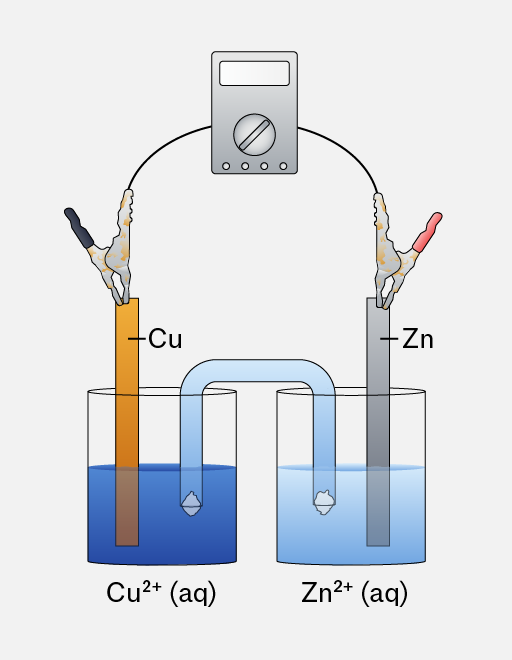
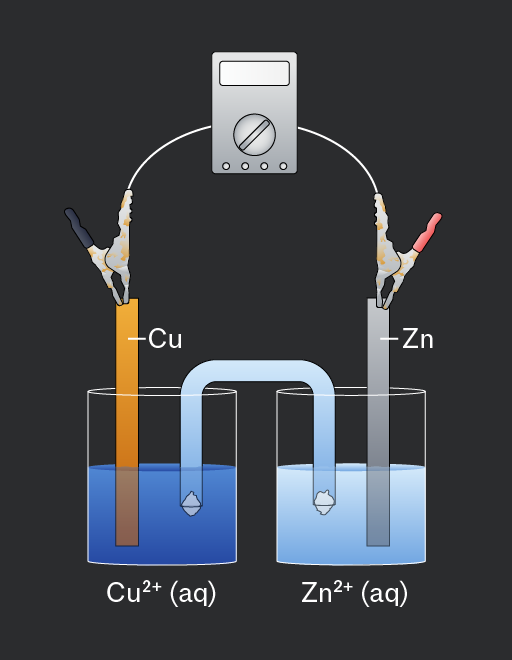
To ensure clean and reactive metal surfaces when preparing an electrode for accurate voltage readings.




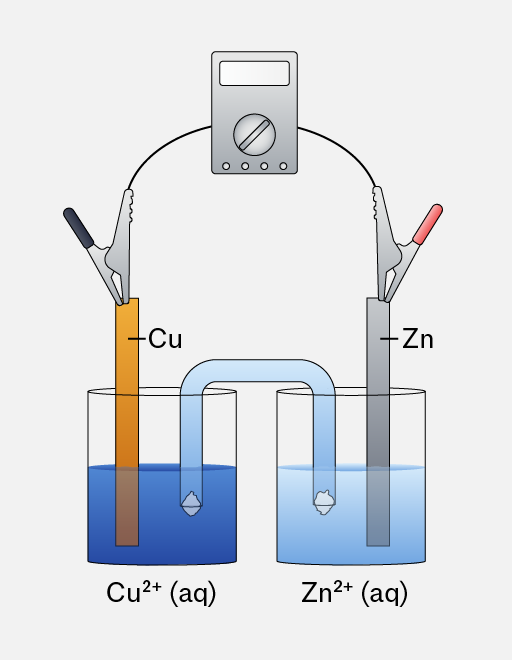
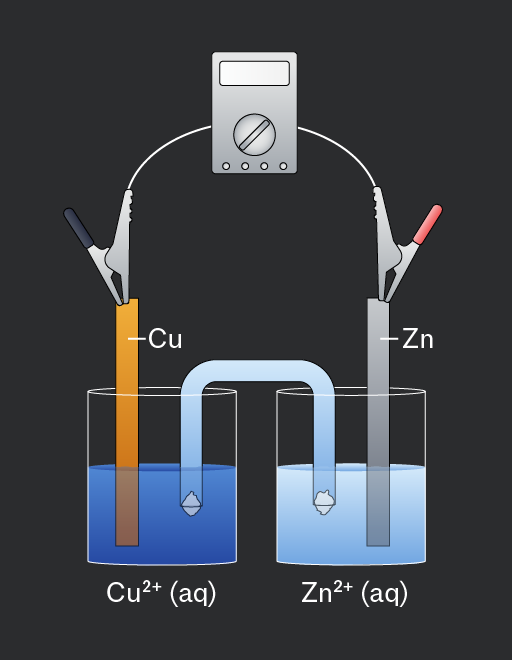
It is important to have strong connections between half cells.
From the calculated values, the can be calculated by using the equation:
Reduction occurs in the right-hand cell and cell oxidation occurs in the left-hand cell.