Practical chemistry for exams›CP 12 - The preparation of a transition metal complex

CP 12 - The preparation of a transition metal complex

An overview of CP 12 - The preparation of a transition metal complex
3 min

In Edexcel Core Practical 12: The preparation of a transition metal complex, a transition metal complex is synthesised by reacting a transition metal salt with a suitable ligand.

This is achieved by reacting copper(II) sulfate solution with ammonia to form a deep blue copper complex. The reaction is carried out in solution, and the transition metal complex is then isolated and crystalised from the solution.

The equation for the reaction is below:

Add to favourites

In Edexcel core practical 12: Prepare a transition metal complex, there are several important safety requirements to be aware of (beyond normal lab practice such as wearing goggles).

  • Wear a lab coat.
  • Concentrated ammonia solution is corrosive and dangerous to the environment – it must be kept in the fume cupboard and handled wearing gloves.
  • Copper salts are harmful and dangerous to the environment.
  • Ethanol is flammable and must be kept away from flames.
Add to favourites
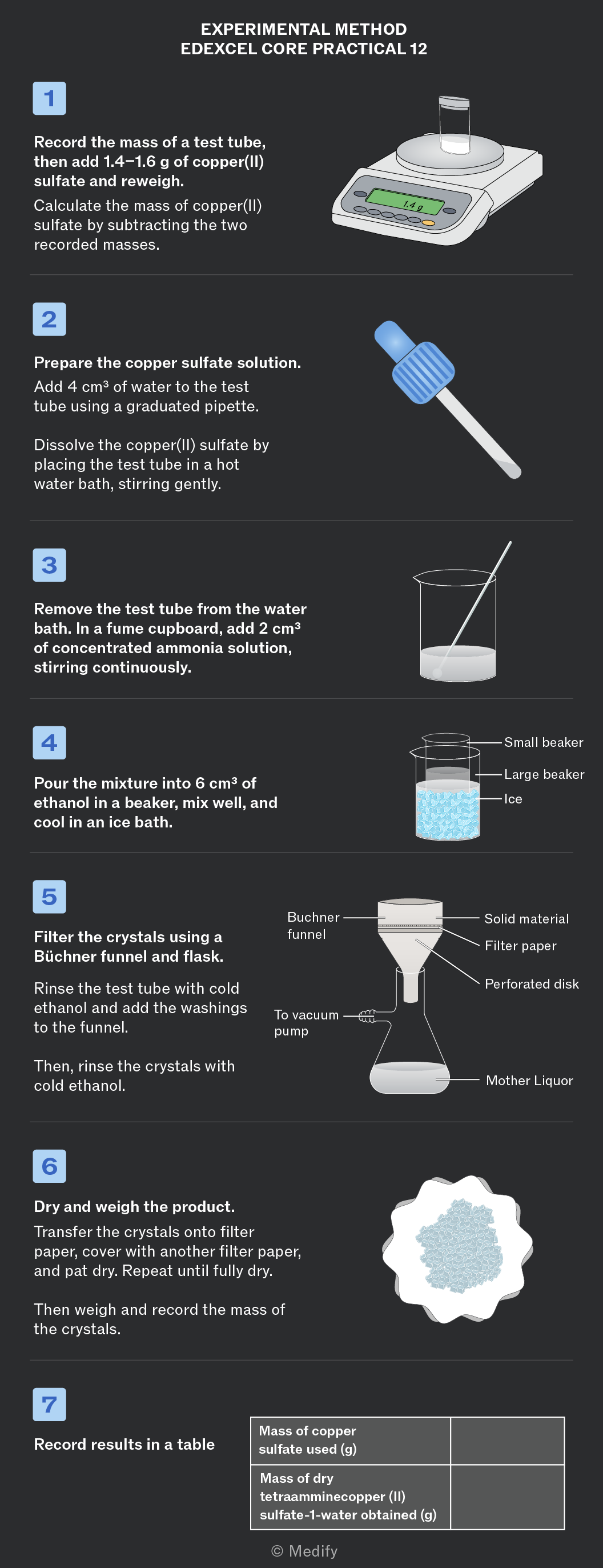
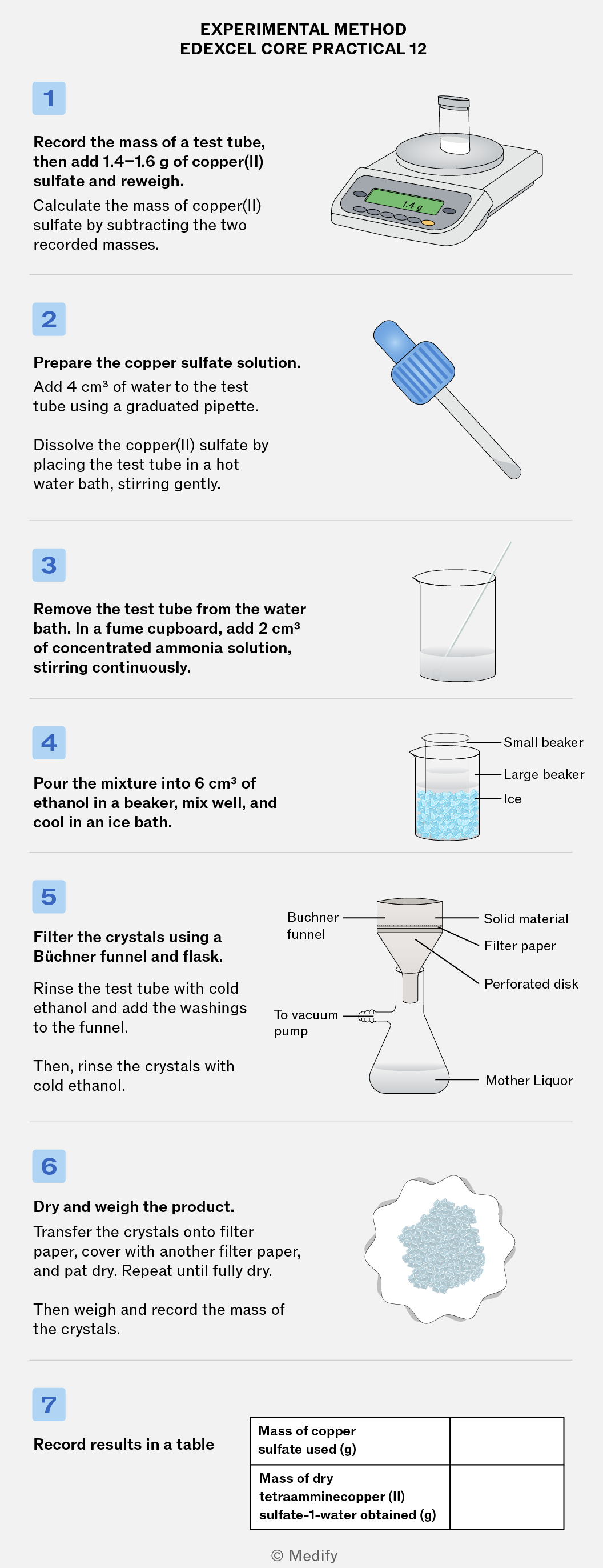
The image is a step-by-step experimental method for Edexcel Core Practical 12. Step 1: Record the mass of a test tube, add 1.4–1.6 g of copper(II) sulfate, and reweigh. Calculate the mass of copper(II) sulfate by subtracting the two recorded masses. An image shows a balance with a test tube on it displaying '1.4 g'. Step 2: Prepare the copper sulfate solution by adding 4 cm³ of water to the test tube using a graduated pipette, dissolve the copper(II) sulfate in a hot water bath, stirring gently. Step 3: Remove the test tube from the water bath, add 2 cm³ of concentrated ammonia solution in a fume cupboard, stirring continuously. Step 4: Pour the mixture into 6 cm³ of ethanol in a beaker, mix well, and cool in an ice bath. An image shows a small beaker inside a large beaker filled with ice. Step 5: Filter the crystals using a Büchner funnel and flask. Rinse the test tube with cold ethanol, add the washings to the funnel, and rinse the crystals with cold ethanol. An image shows a Büchner funnel with labels: 'Solid material', 'Filter paper', 'Perforated disk', 'To vacuum pump', and 'Mother Liquor'. Step 6: Dry and weigh the product by transferring the crystals onto filter paper, cover with another filter paper, and pat dry. Weigh and record the mass of the crystals. An image shows dry crystals. Step 7: Record results in a table with columns labeled 'Mass of copper sulfate used (g)' and 'Mass of dry tetraamminecopper (II) sulfate-1-water obtained (g)'.
Add to favourites

Ensuring proper ventilation during chemical testing is critical to avoid inhaling harmful fumes, such as ammonia or sulfuric acid vapours, which can irritate the respiratory system.
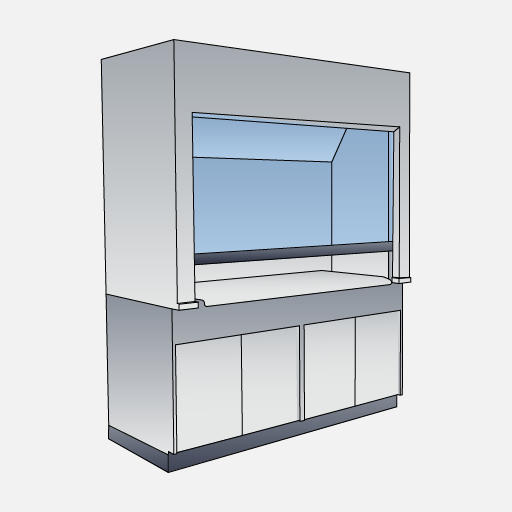
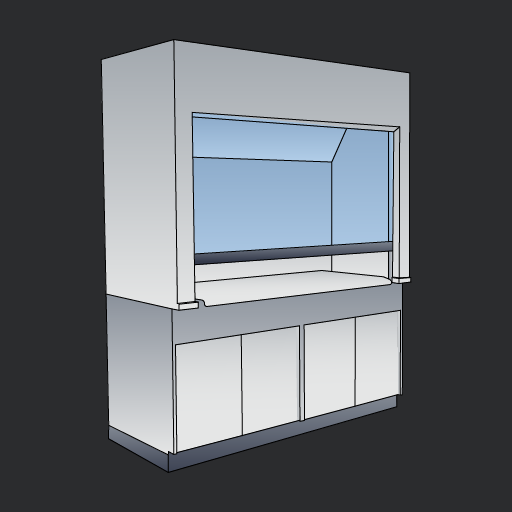
A simple illustration of a display cabinet featuring a transparent upper section with a blue background and a solid lower section with two doors.
Do

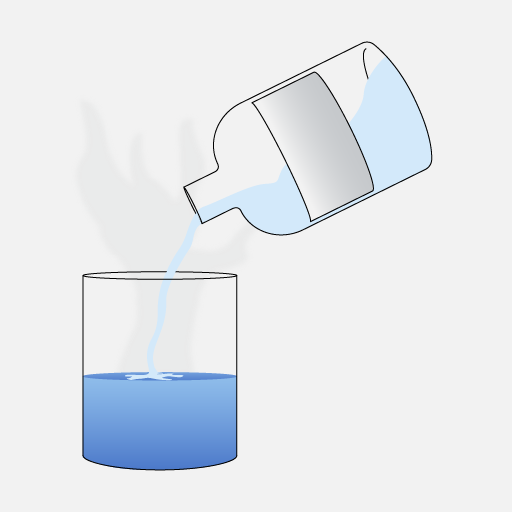
Conduct all tests in a well-ventilated area or under a fume cupboard to avoid inhaling harmful fumes or gases, such as ammonia or sulfuric acid vapours.

A bottle pouring blue liquid into a glass, with steam rising from the glass.
Don't

Perform the tests in an enclosed or poorly ventilated space, as this can lead to the accumulation of dangerous gases.

Add to favourites

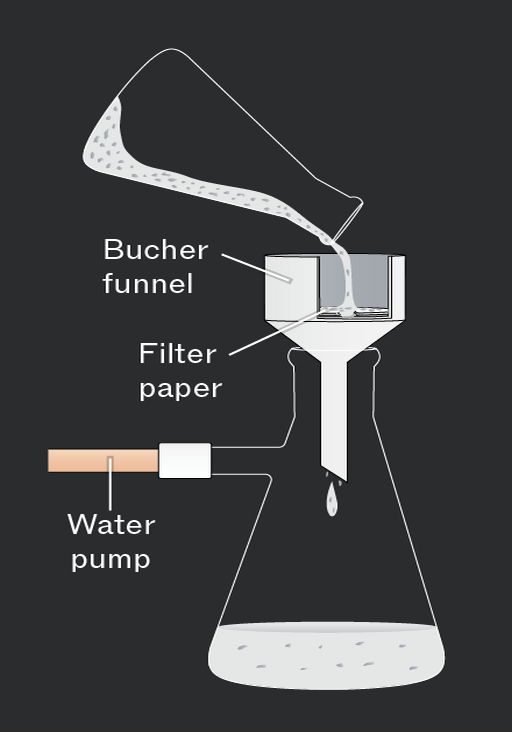
Take care when filtering the aspirin product under reduced pressure.
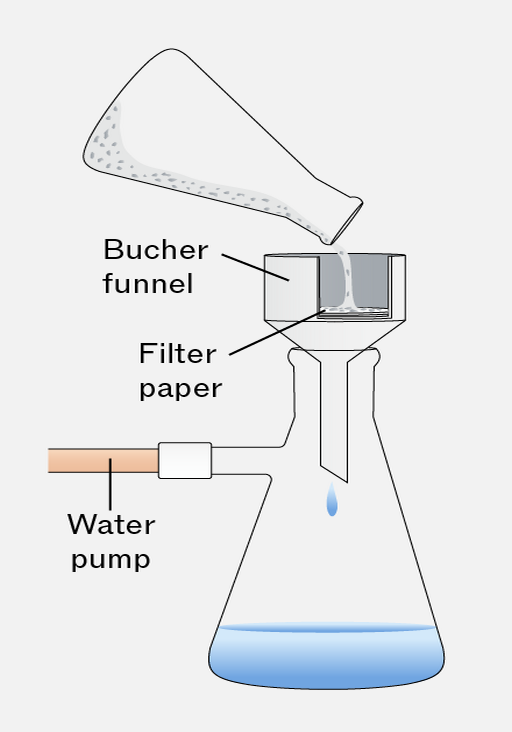
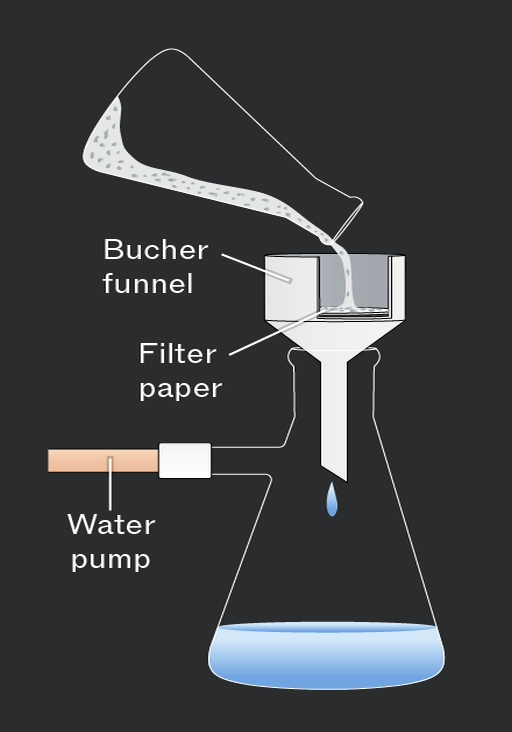
A diagram illustrating a Bucher funnel setup. The image includes a Bucher funnel at the top, with filter paper inside it. Below, a flask is connected to a water pump, and a drop of liquid is shown falling from the funnel into the flask.
Do

Filter the aspirin gently under reduced pressure to collect the solid efficiently. Dampening the filter paper and starting the suction before adding the reaction mixture creates a good seal.

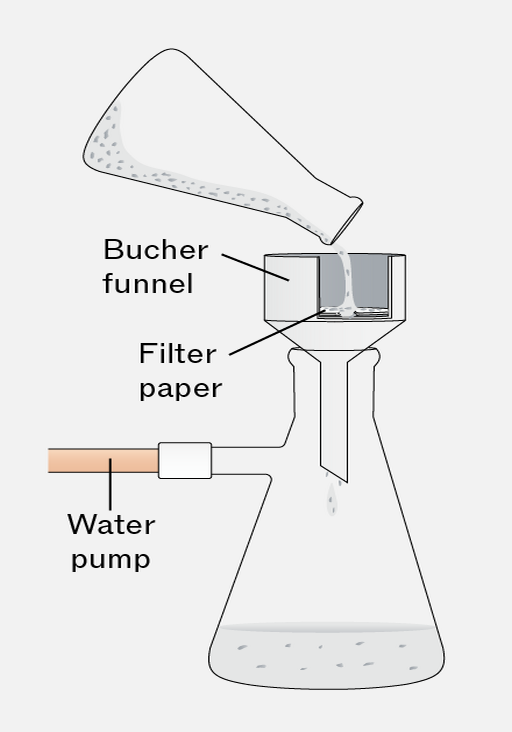
A diagram illustrating a Bucher funnel setup, with labeled components including a Bucher funnel, filter paper, and a water pump connected to a flask.
Don't

Apply excessive force during filtration – this could cause the filter paper to tear and the solid to be sucked through to the collection vessel.

Add to favourites

First, calculate the moles of by using the equation:

From this, using the balanced equation, calculate the moles of the ratio being 1:1.

Then calculate the mass to obtain the theoretical yield, using the equation:

Calculate the % yield by using your mass obtained as the actual yield into the equation:

Add to favourites