Practical chemistry for exams›CP 13a - Following the rate of the iodine-propanone reaction by a titrimetric method

CP 13a - Following the rate of the iodine-propanone reaction by a titrimetric method

An overview of CP 13a - Following the rate of the iodine-propanone reaction by a titrimetric method
3 min

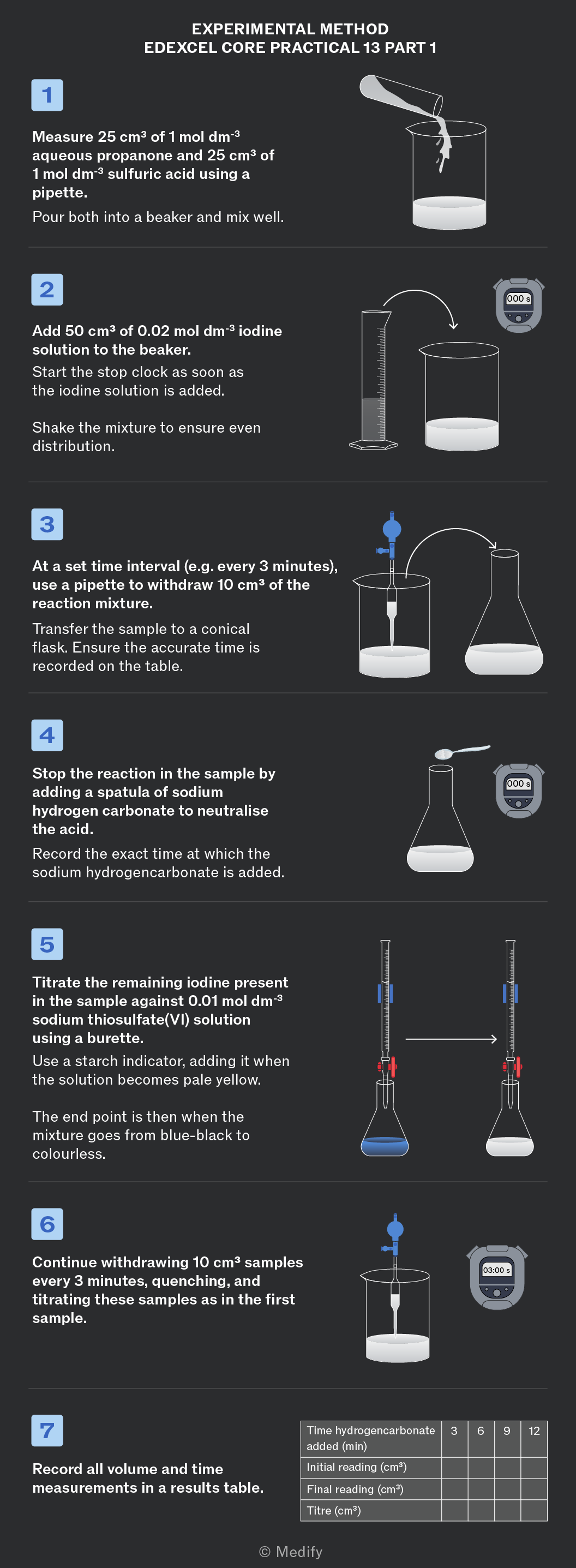
In Edexcel Core Practical 13a: Following the rate of the iodine–propanone reaction by a titrimetric method you will investigate the rate of the iodine–propanone reaction by monitoring the concentration of iodine over time.

This is achieved by reacting iodine with propanone in an acidic solution. Samples are taken at regular intervals, and the iodine concentration is determined using a titrimetric method, where iodine is titrated with a sodium thiosulfate solution.

Add to favourites

In Edexcel core practical 13a: Follow the rate of the iodine–propanone reaction using a titrimetric method, there are several important safety requirements to be aware of (beyond normal lab practice such as wearing goggles).

  • The product, iodopropanone, is a lachrymator (strong eye irritant) – pour the reaction mixture down a fume cupboard sink with plenty of running water immediately measurements are complete.
  • Sodium thiosulfate releases sulfur dioxide when it reacts. Ensure that the room is well ventilated.
  • Propanone is an irritant and is highly flammable – avoid use near naked flames.
  • Sulfuric acid solution is an irritant.
  • Do not run this practical for more than 12 minutes in total.
Add to favourites
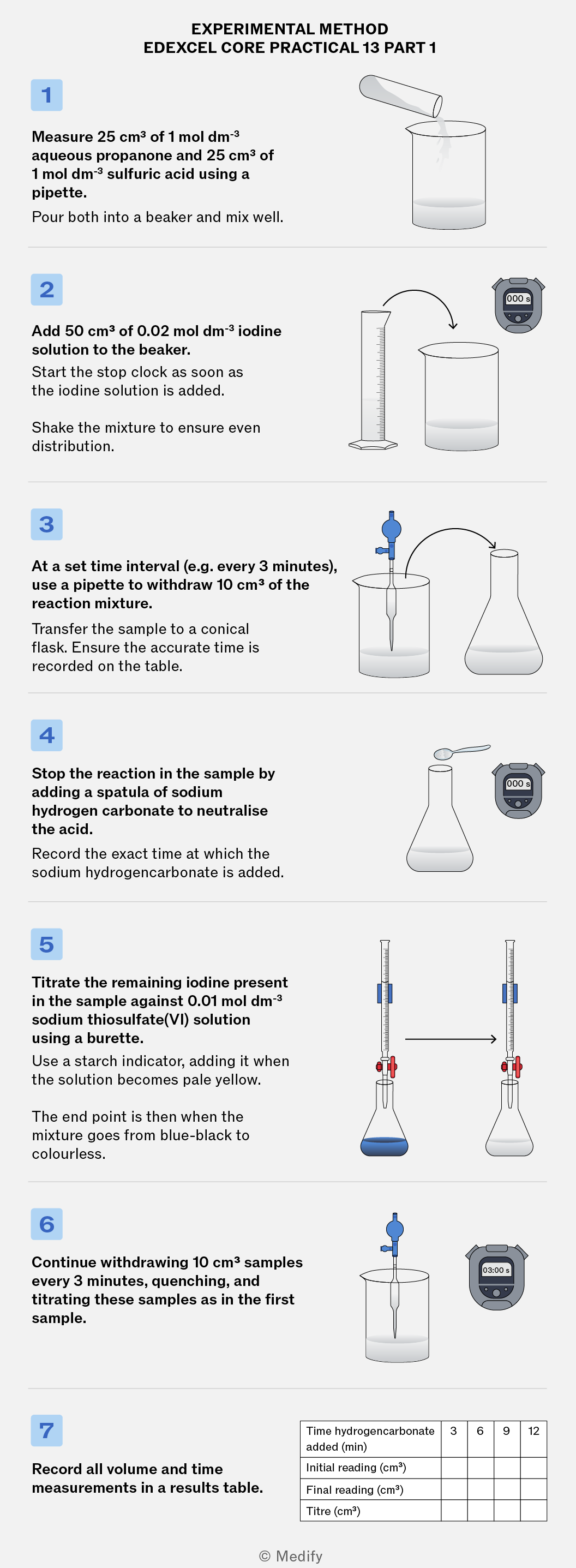
The image is a step-by-step guide titled 'Experimental Method Edexcel Core Practical 13 Part 1'. It includes instructions and illustrations for a chemical experiment. Step 1: Measure 25 cm³ of 1 mol dm⁻³ aqueous propanone and 25 cm³ of 1 mol dm⁻³ sulfuric acid using a pipette. Pour both into a beaker and mix well. Step 2: Add 50 cm³ of 0.02 mol dm⁻³ iodine solution to the beaker. Start the stopwatch as soon as the iodine solution is added. Shake the mixture to ensure even distribution. Step 3: At set time intervals (e.g., every 3 minutes), use a pipette to withdraw 10 cm³ of the reaction mixture. Transfer the sample to a conical flask. Ensure the accurate time is recorded on the table. Step 4: Stop the reaction in the sample by adding a spatula of sodium hydrogen carbonate to neutralize the acid. Record the exact time at which the sodium hydrogencarbonate is added. Step 5: Titrate the remaining iodine present in the sample against 0.01 mol dm⁻³ sodium thiosulfate(VI) solution using a burette. Use a starch indicator, adding it when the solution becomes pale yellow. The endpoint is when the mixture goes from blue-black to colourless. Step 6: Continue withdrawing 10 cm³ samples every 3 minutes, quenching, and titrating these samples as in the first sample. Step 7: Record all volume and time measurements in a results table. The results table has columns for 'Time hydrogencarbonate added (min)' with values 3, 6, 9, 12, 'Initial reading (cm³)', 'Final reading (cm³)', and 'Titre (cm³)'.
Add to favourites

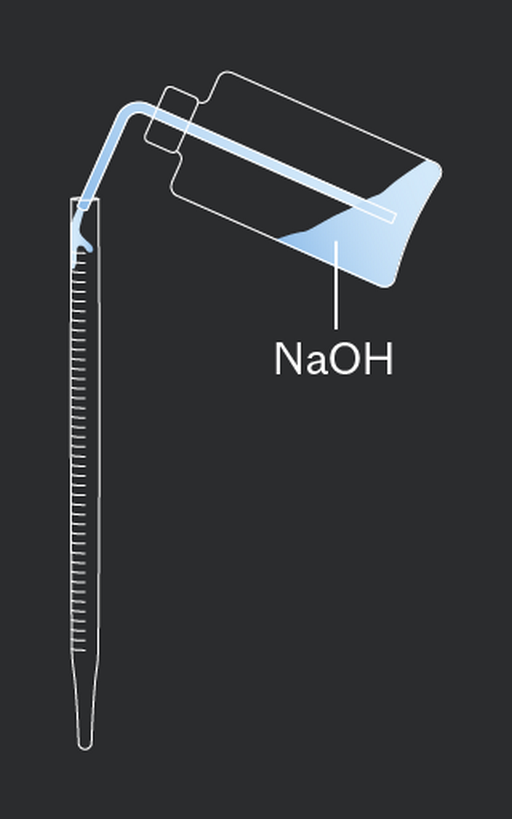
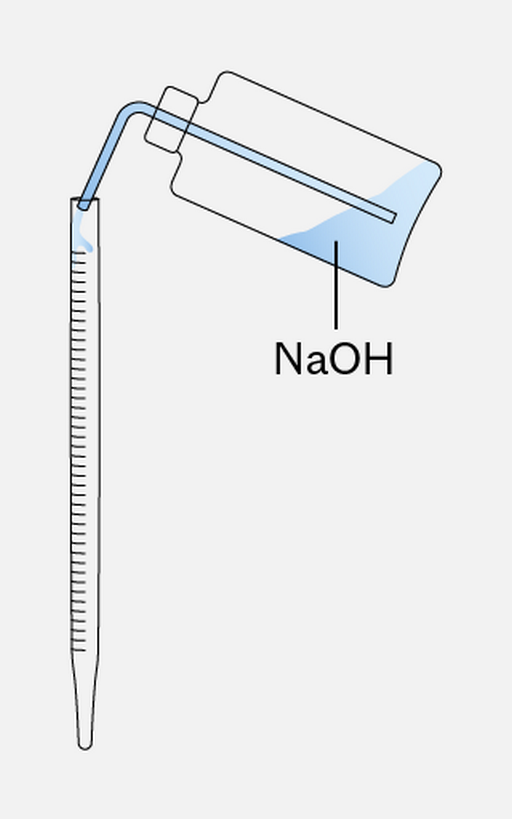
Avoid unintentional dilution of solutions.
A laboratory pipette with a graduated scale on the side, positioned next to a container labeled NaOH, indicating the presence of sodium hydroxide.
Do

Rinse all glassware used for accurately measuring solution volumes with the solution itself.

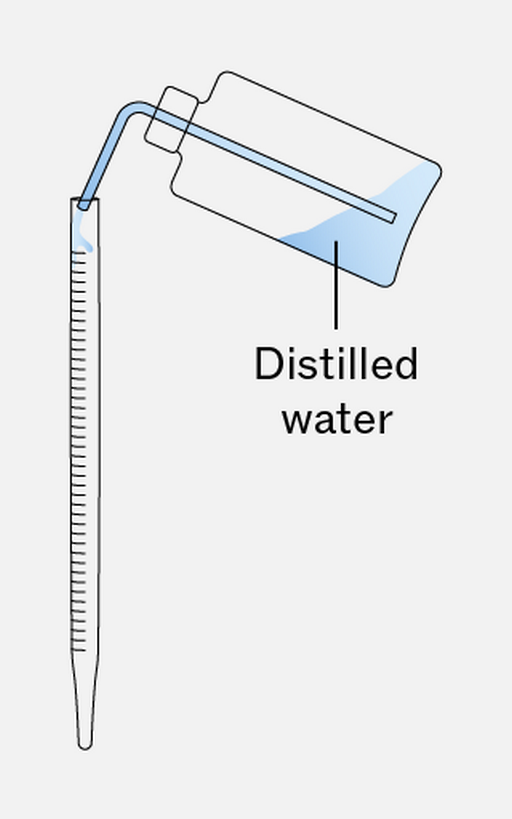
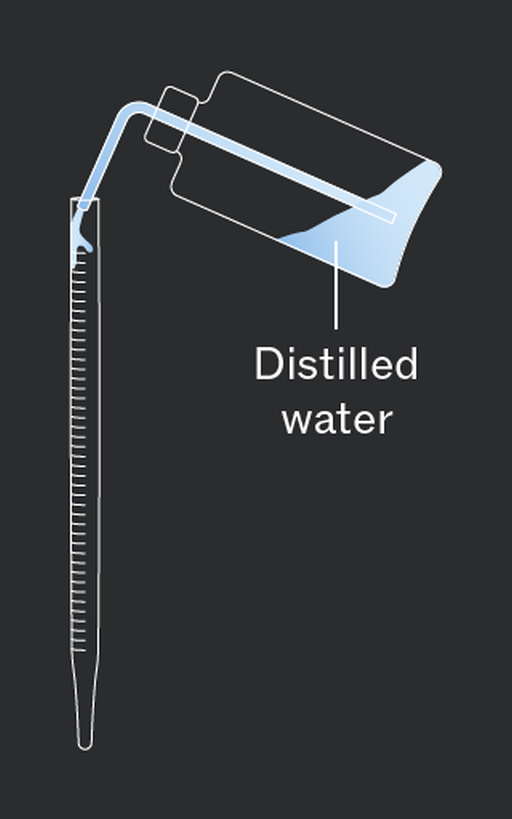
A pipette is shown with a container above it labeled 'Distilled water'.
Don't

Rinse precision glassware with water immediately before use – leftover water will dilute the solution.

Add to favourites

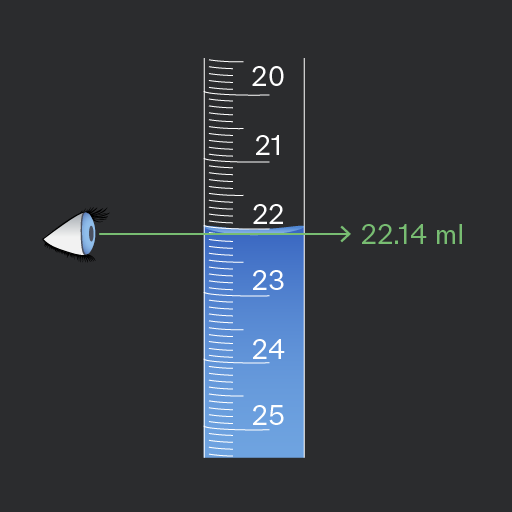
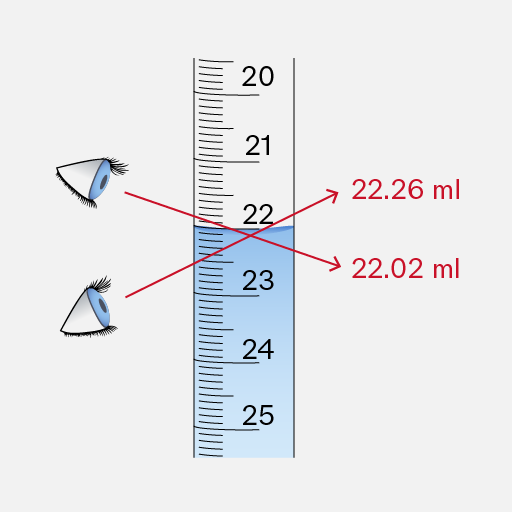
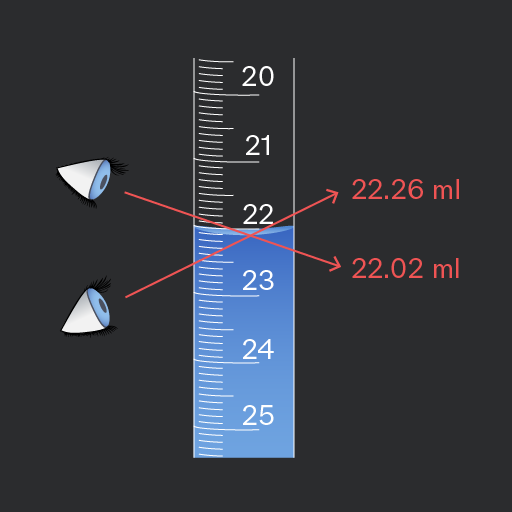
Prevent parallax errors when reading volumes.
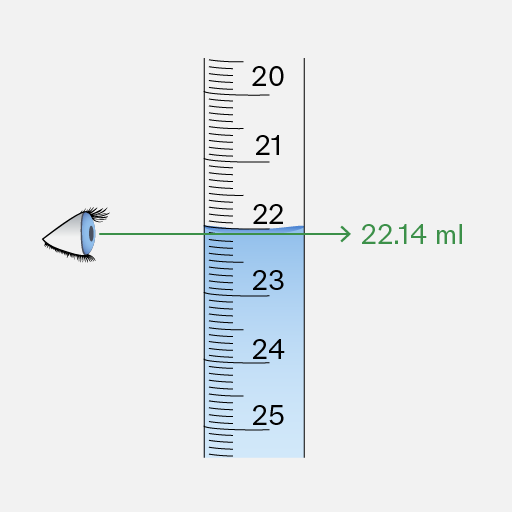
An illustration showing a measuring cylinder with a scale marked from 20 to 25 ml. An eye is depicted on the left side, and a green arrow points to the measurement of 22.14 ml.
Do

Read the burette at eye level and record to

A measurement scale showing values from 20 to 25 ml. Two eyes are illustrated, one pointing to 22.26 ml and the other to 22.02 ml, with red arrows indicating the measurements.
Don't

Read from above or below – this leads to incorrect readings due to parallax error.

Add to favourites

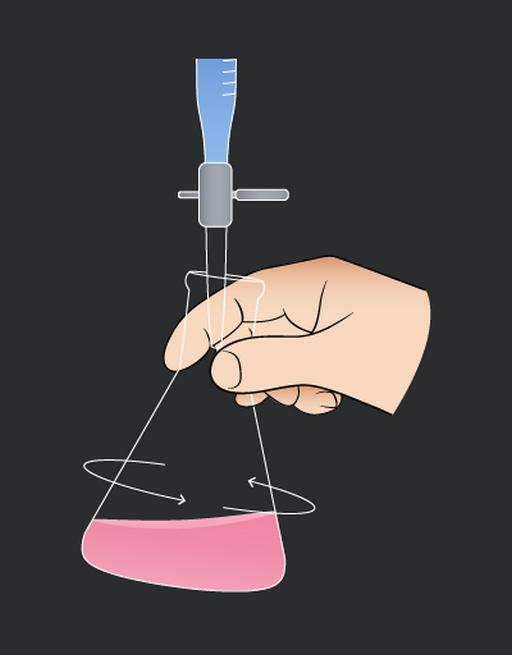
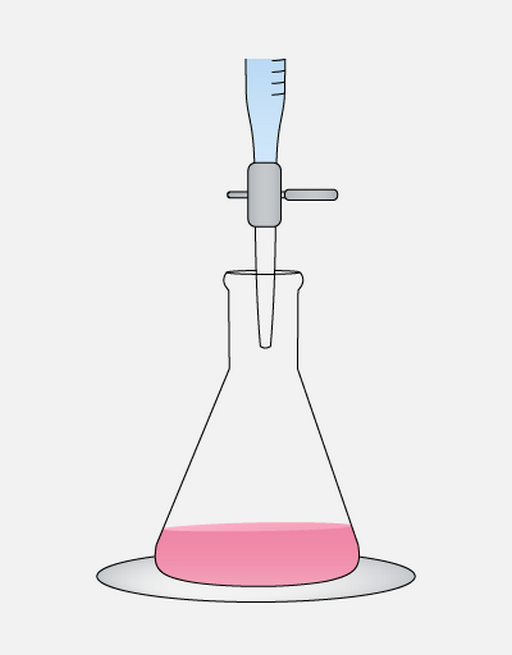
Keep the titration mixture well mixed.
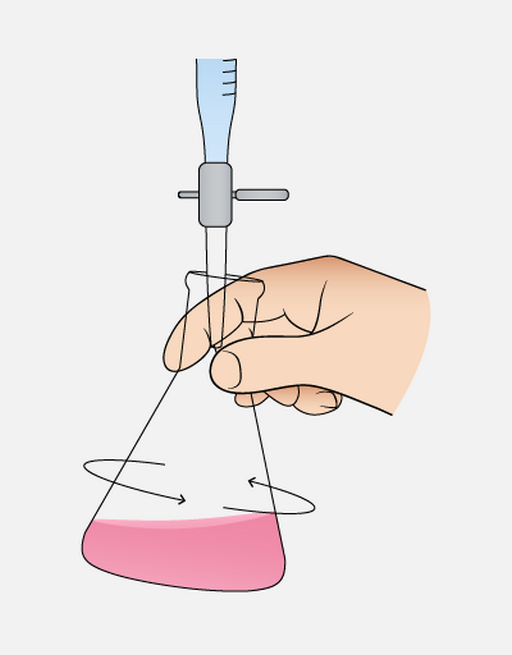
A hand holding a conical flask containing a pink liquid, with arrows indicating swirling motion, and a dropper above the flask.
Do

Swirl the conical flask gently and consistently during titration to ensure complete contact between reactants.

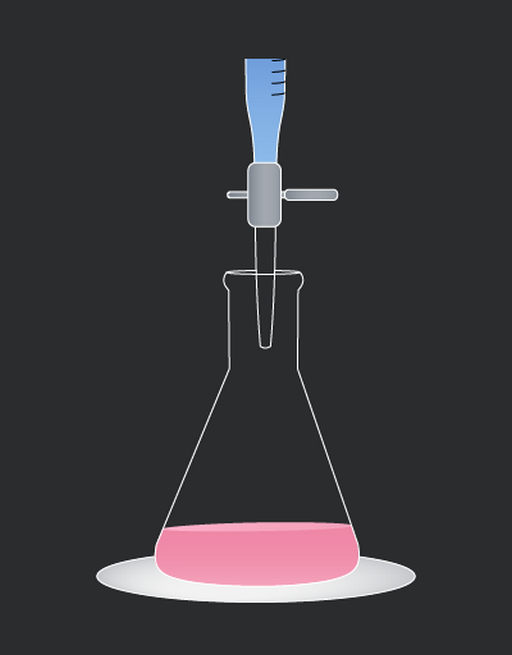
A laboratory setup featuring a conical flask with a pink liquid inside, topped with a pipette holder and a blue pipette.
Don't

Leave the flask still during titration – without swirling, the acid and alkali will not mix properly, leading to an inaccurate endpoint.

Add to favourites

Accurately measuring time is essential in rate investigations.
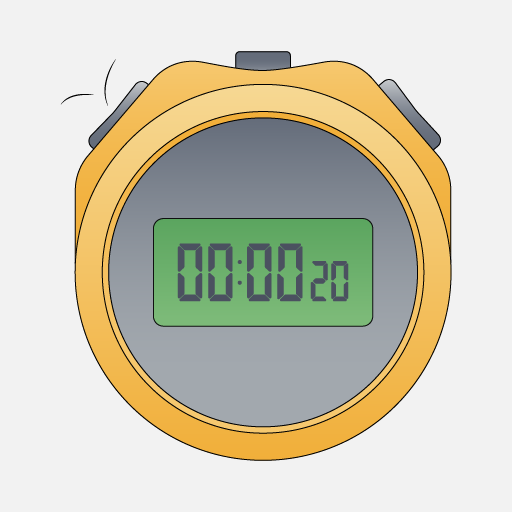
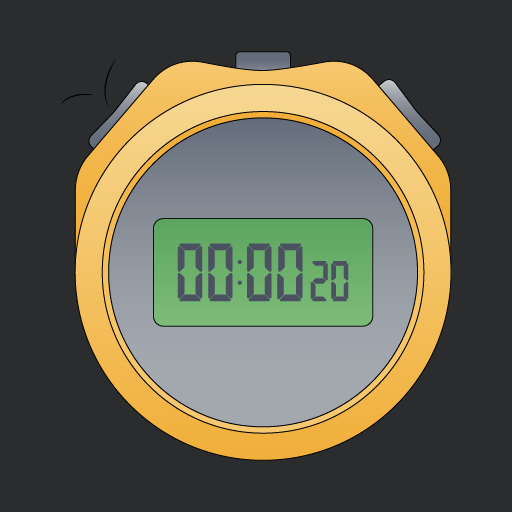
A round yellow stopwatch displaying the time 00:00:20 on a green digital screen.
Do

Start timing immediately after mixing reagents to ensure an accurate measurement of the reaction rate.

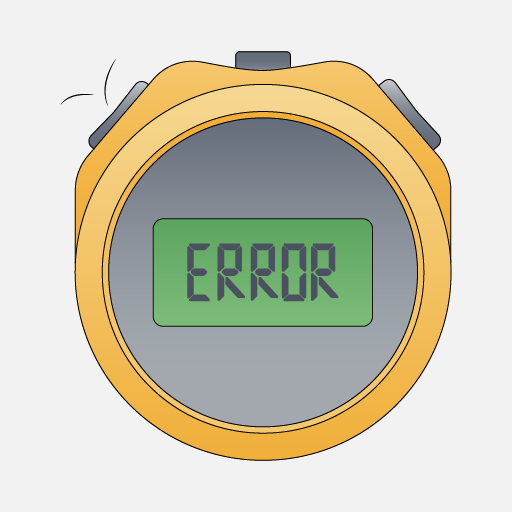
A round yellow stopwatch displaying the word 'ERROR' in large green letters on its screen.
Don't

Stop the timer to take measurements. The reaction hasn’t stopped, so neither should the timer.

Add to favourites

Plot a graph of the titre against time (the titre is proportional to the concentration of iodine).

The order of reaction with respect to iodine from the graph can be deduced from its shape.

Add to favourites