Module 1: Practical chemistry for exams›PAG 4.1- Identifying unknowns 1

PAG 4.1- Identifying unknowns 1

An overview of PAG 4.1- Identifying unknowns 1
4 min

In OCR Chemistry Required Practical 4 (PAG 4.1), two salts of the same Group 2 metal in a mixture are identified through solubility patterns and qualitative tests for anions.

Add to favourites

In OCR PAG 4.1: Identifying unknowns 1, there are several important safety requirements to be aware of (beyond normal lab practice such as wearing goggles).

  • Unknown solutions should always be treated as irritants.
  • Wear protective gloves when handling
  • Inhalation of chemicals can cause irritation and be harmful – ensure that the area is well ventilated.
Add to favourites

Experimental method for OCR Chemistry Required Practical 4 (PAG 4.1)

Part 1 – Preparation of the sample.
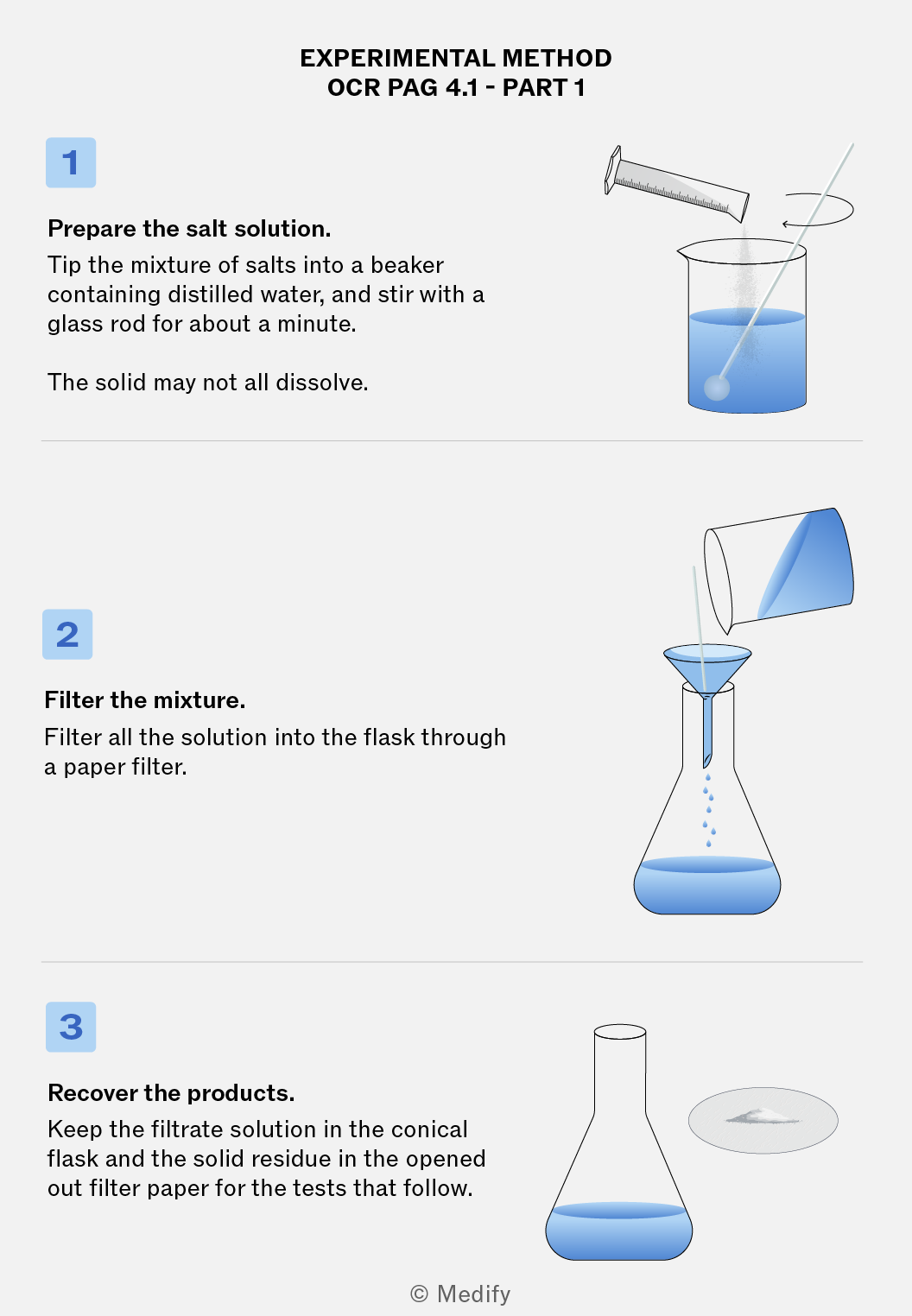
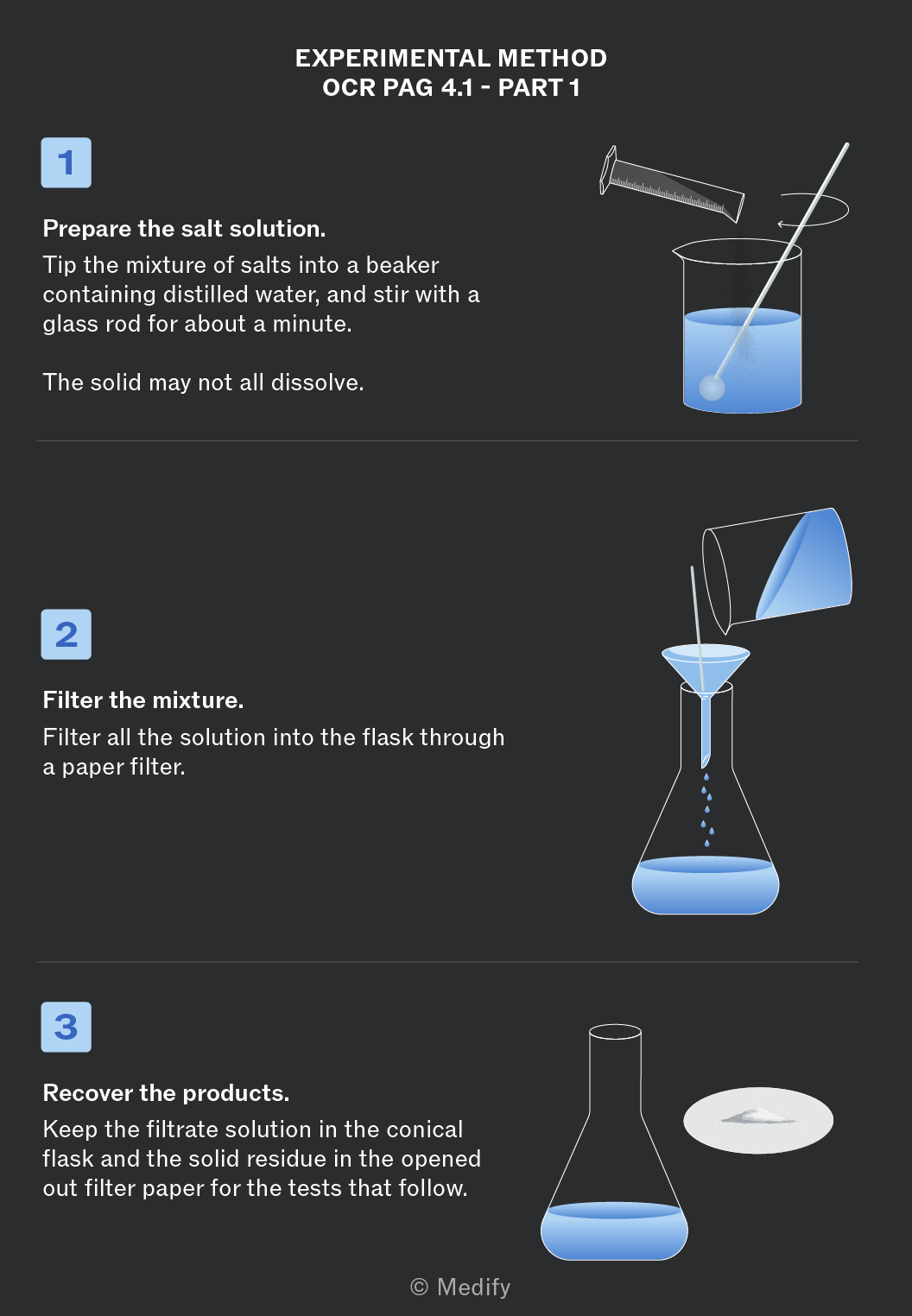
EXPERIMENTAL METHOD OCR PAG 4.1 - PART 1. 1 Prepare the salt solution. Tip the mixture of salts into a beaker containing distilled water, and stir with a glass rod for about a minute. The solid may not all dissolve. 2 Filter the mixture. Filter all the solution into the flask through a paper filter. 3 Recover the products. Keep the filtrate solution in the conical flask and the solid residue in the opened out filter paper for the tests that follow.
Add to favourites

Experimental method for OCR Chemistry Required Practical 4 (PAG 4.1)

Part 2 – Identification of anions.
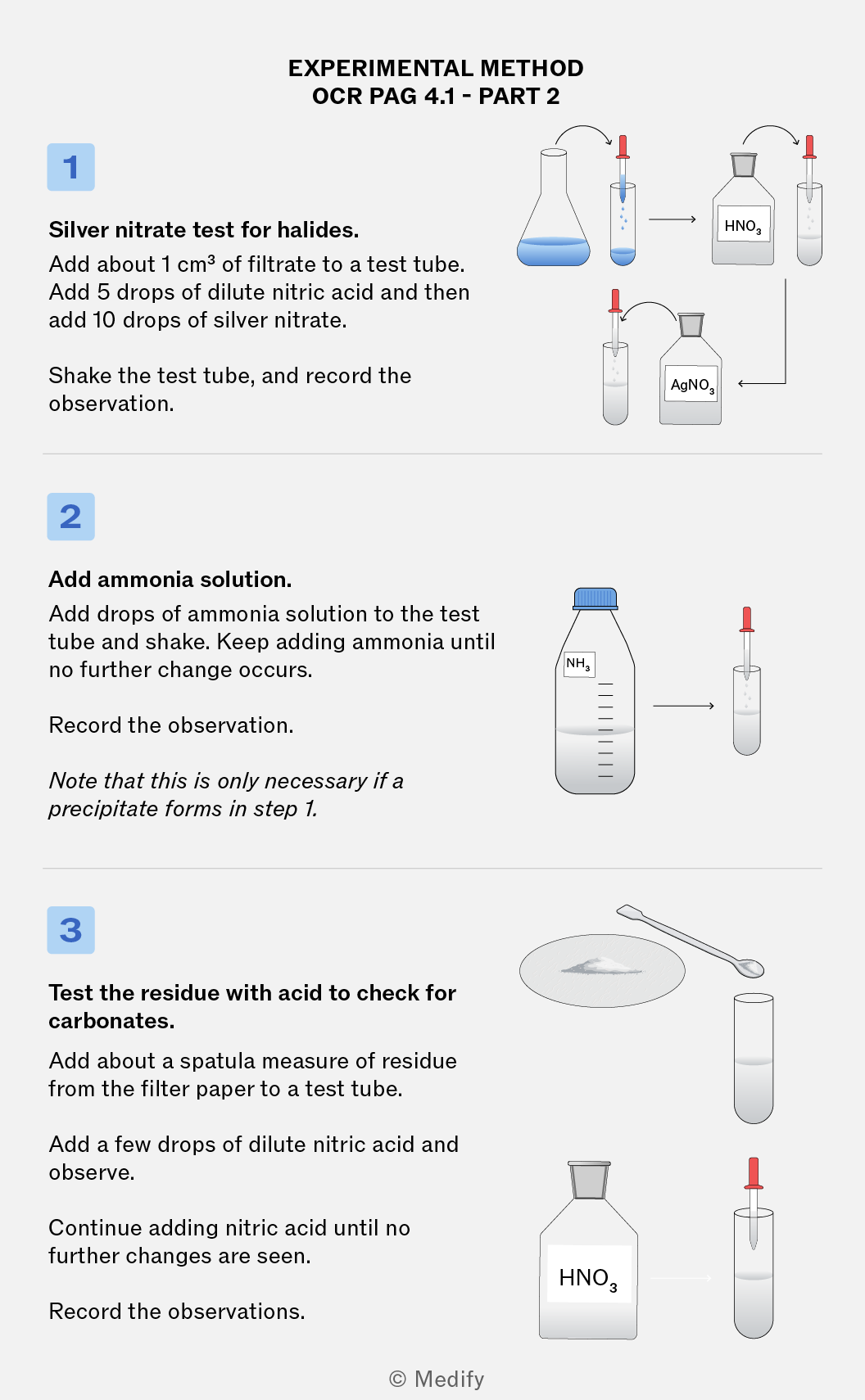
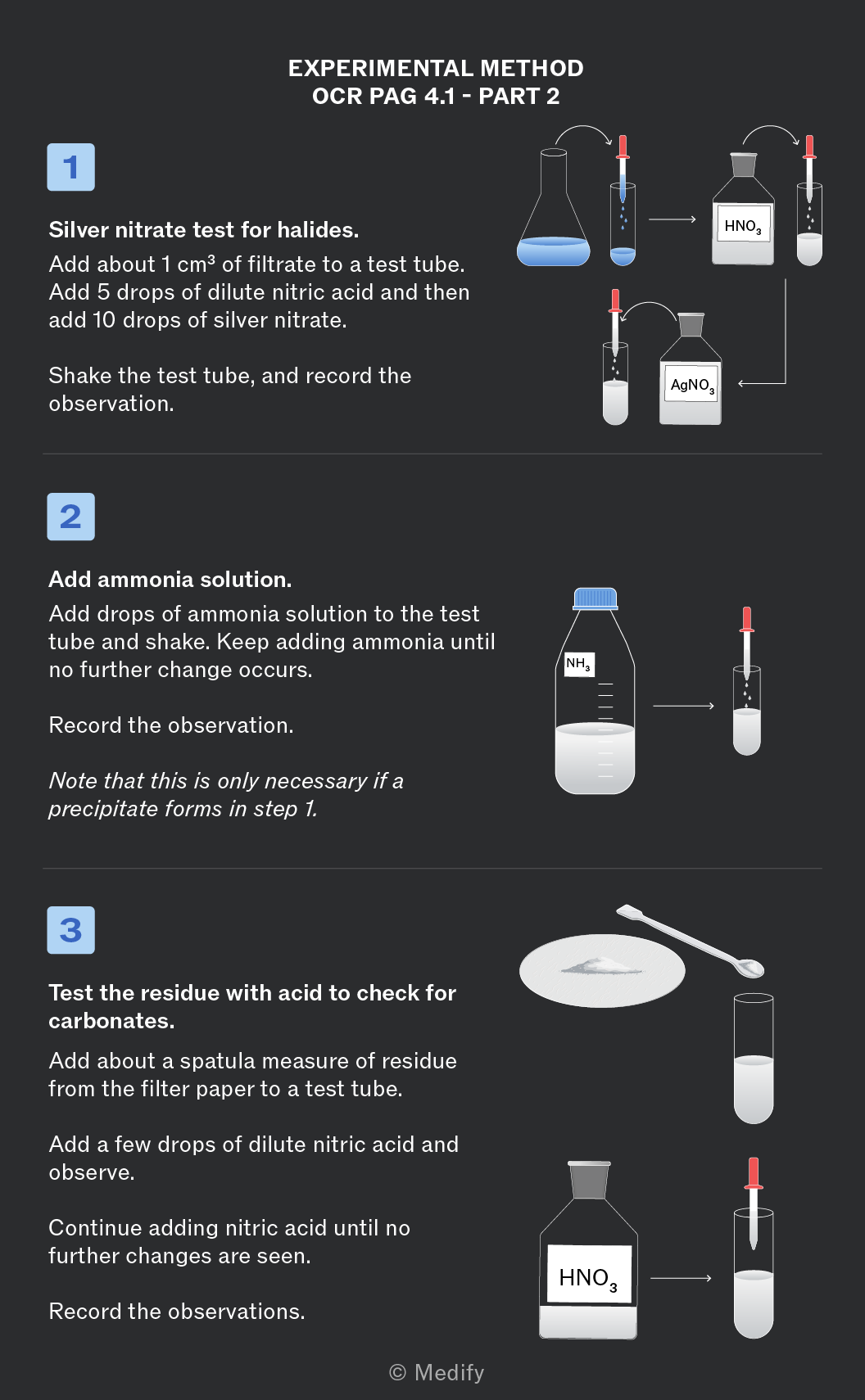
EXPERIMENTAL METHOD OCR PAG 4.1 - PART 2. 1. Silver nitrate test for halides. Add about 1 cm³ of filtrate to a test tube. Add 5 drops of dilute nitric acid and then add 10 drops of silver nitrate. Shake the test tube, and record the observation. 2. Add ammonia solution. Add drops of ammonia solution to the test tube and shake. Keep adding ammonia until no further change occurs. Record the observation. Note that this is only necessary if a precipitate forms in step 1. 3. Test the residue with acid to check for carbonates. Add about a spatula measure of residue from the filter paper to a test tube. Add a few drops of dilute nitric acid and observe. Continue adding nitric acid until no further changes are seen. Record the observations.
Add to favourites

Experimental method for OCR Chemistry Required Practical 4 (PAG 4.1)

Part 3 – Identification of group 2 cation.
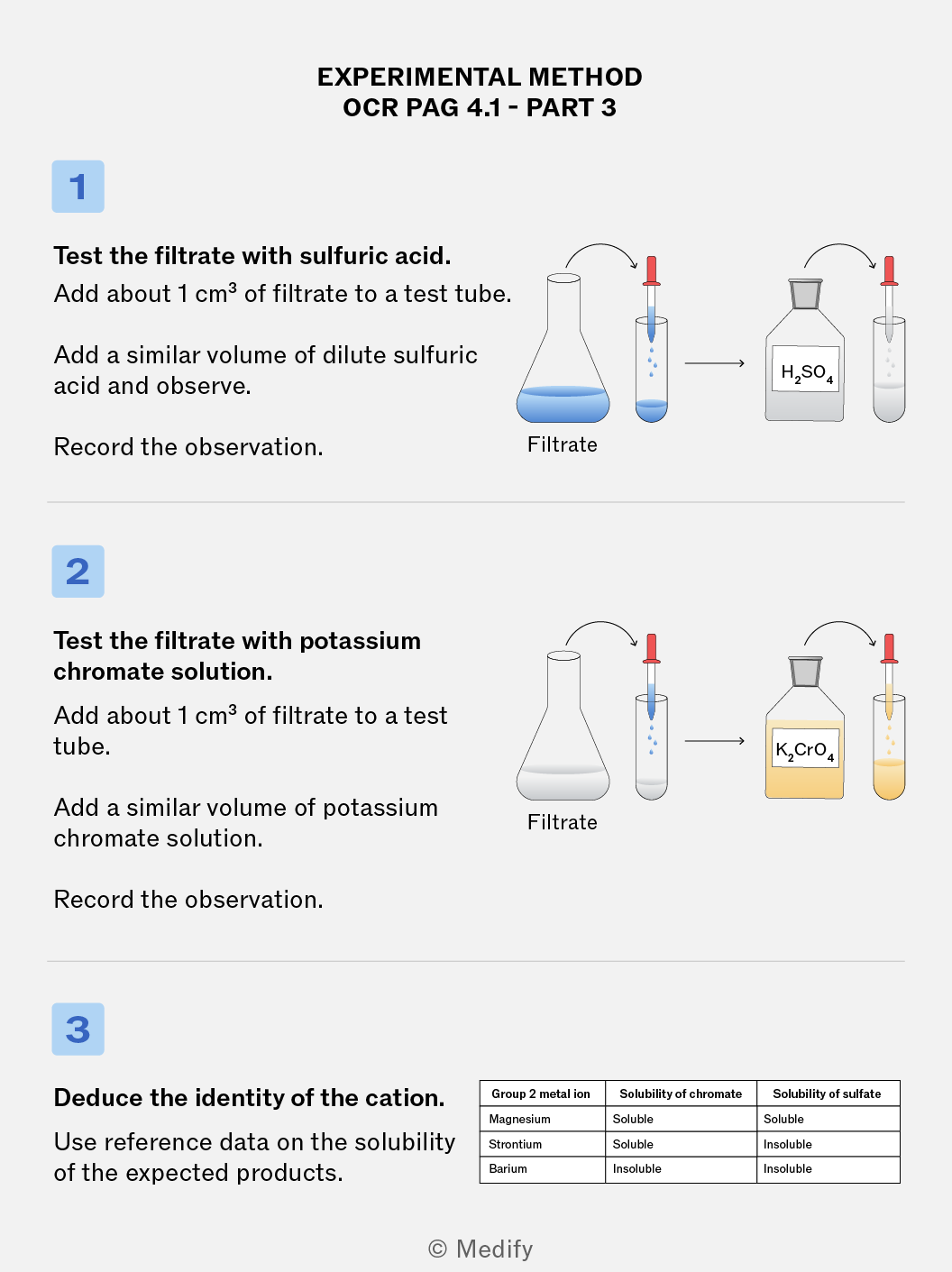
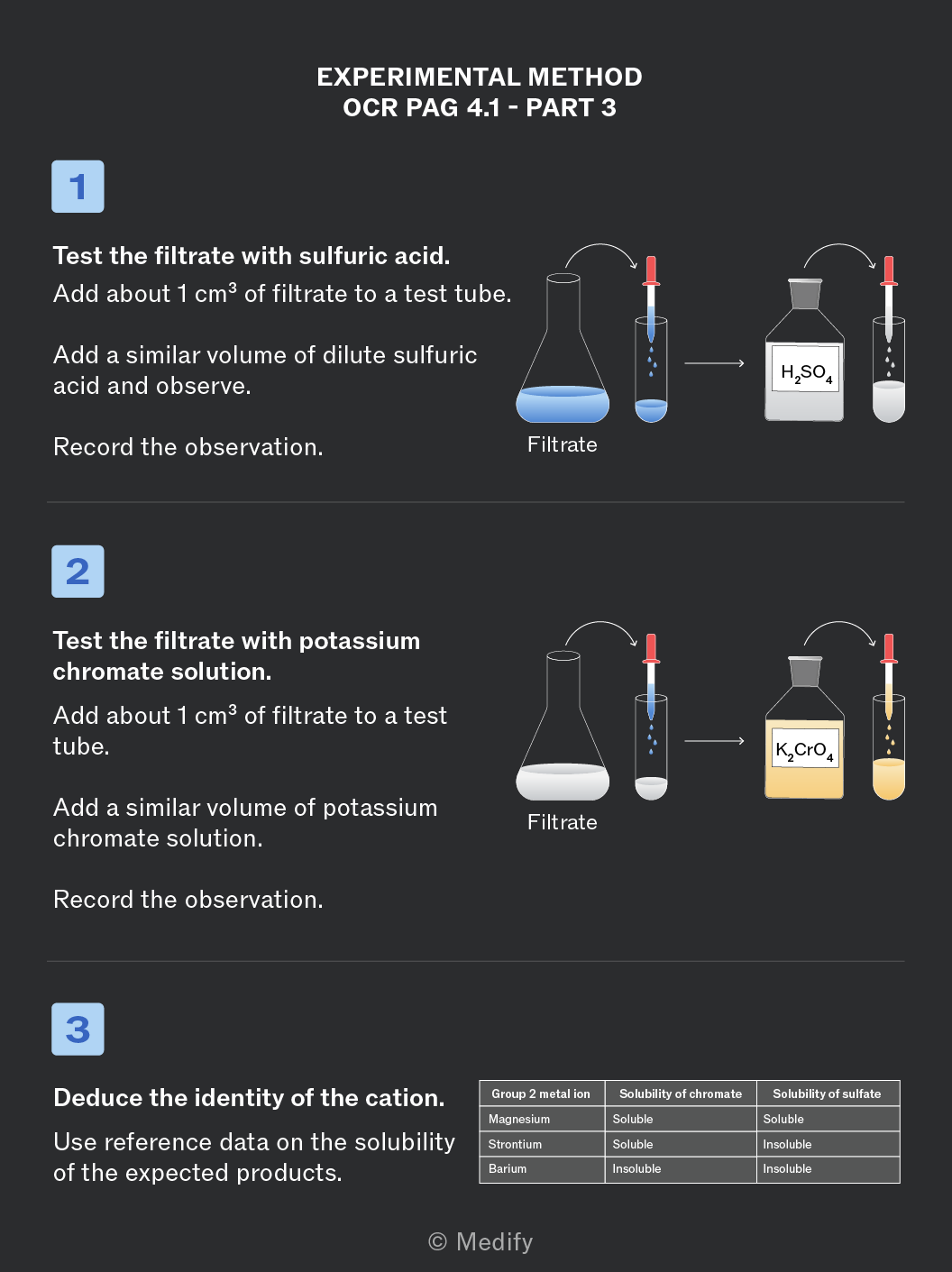
EXPERIMENTAL METHOD OCR PAG 4.1 - PART 3. 1. Test the filtrate with sulfuric acid. Add about 1 cm³ of filtrate to a test tube. Add a similar volume of dilute sulfuric acid and observe. Record the observation. Filtrate. 2. Test the filtrate with potassium chromate solution. Add about 1 cm³ of filtrate to a test tube. Add a similar volume of potassium chromate solution. Record the observation. Filtrate. 3. Deduce the identity of the cation. Use reference data on the solubility of the expected products. Group 2 metal ion, Solubility of chromate, Solubility of sulfate. Magnesium, Soluble, Soluble. Strontium, Soluble, Insoluble. Barium, Insoluble, Insoluble. © Medify
Add to favourites

Wearing the appropriate personal protective equipment is essential to avoid direct contact with harmful chemicals and to ensure safety throughout the experiment.
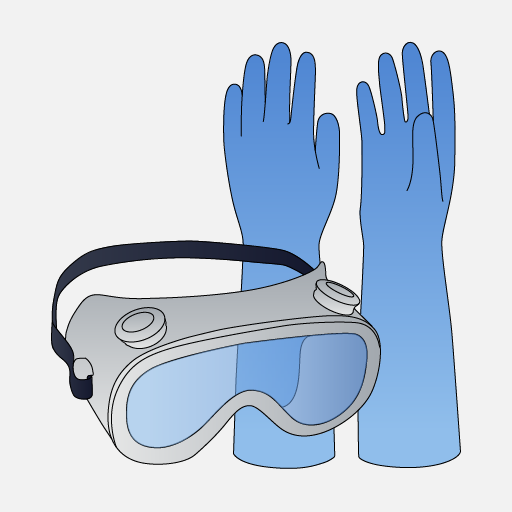

A simple illustration of a pair of goggles and gloves.
Do

Wear goggles and gloves when handling any chemicals, particularly concentrated acids, ammonia, and metal salts, as they can be corrosive or irritating to the skin and eyes.

A person wearing no goggles or gloves whilst handling chemicals.
Don't

Skip protective equipment just because ‘it’s only a few drops’.

Add to favourites

It is crucial to use clean and dry glassware when performing analytical tests.
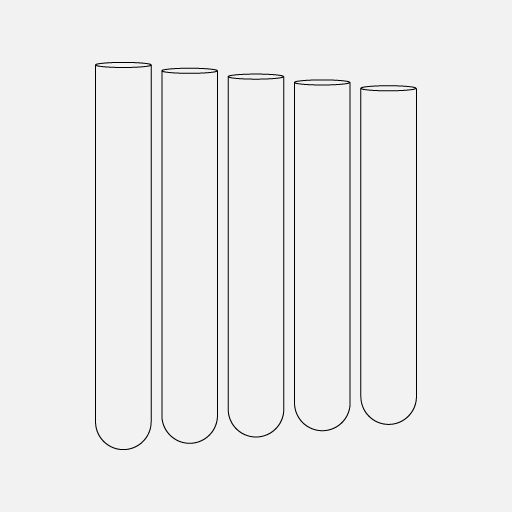
Five test tubes arranged in a row, with varying heights and shapes.
Do

Ensure all glassware is clean and dry before use to avoid contamination and ensure accurate results.

A test tube with a white body and brownish stains or markings on its surface.
Don't

Reuse glassware that has not been properly cleaned and dried, as this could lead to inaccurate readings or unintended chemical reactions.

Add to favourites

Proper disposal of chemicals is essential to avoid environmental damage and ensure safe laboratory practices. Always follow disposal guidelines.
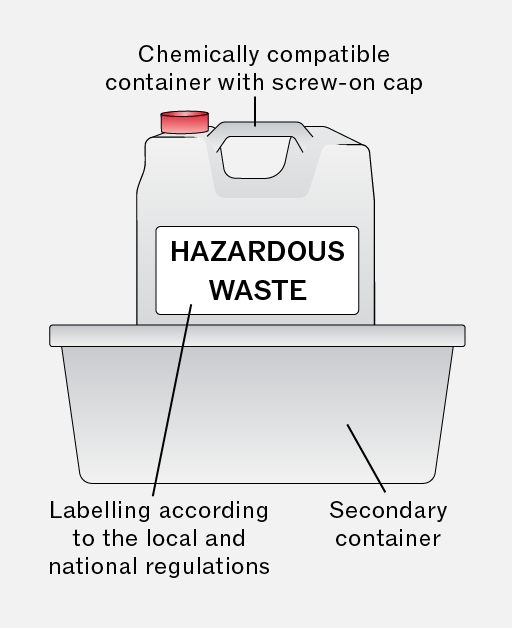
A diagram showing a chemically compatible container with screw-on cap labeled 'HAZARDOUS WASTE' placed inside a secondary container. There are labels indicating 'Labelling according to the local and national regulations'.
Do

Dispose of chemicals safely after testing by placing them in the designated waste containers. Always follow your teacher’s instructions for disposal.

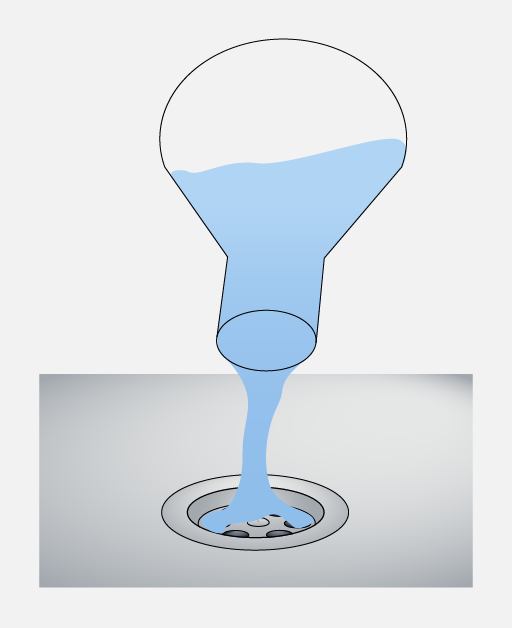
A funnel pouring blue liquid into a drain.
Don't

Pour chemicals down the drain unless specifically directed to do so, as some chemicals may cause harmful reactions in the plumbing or be harmful to aquatic organisms.

Add to favourites

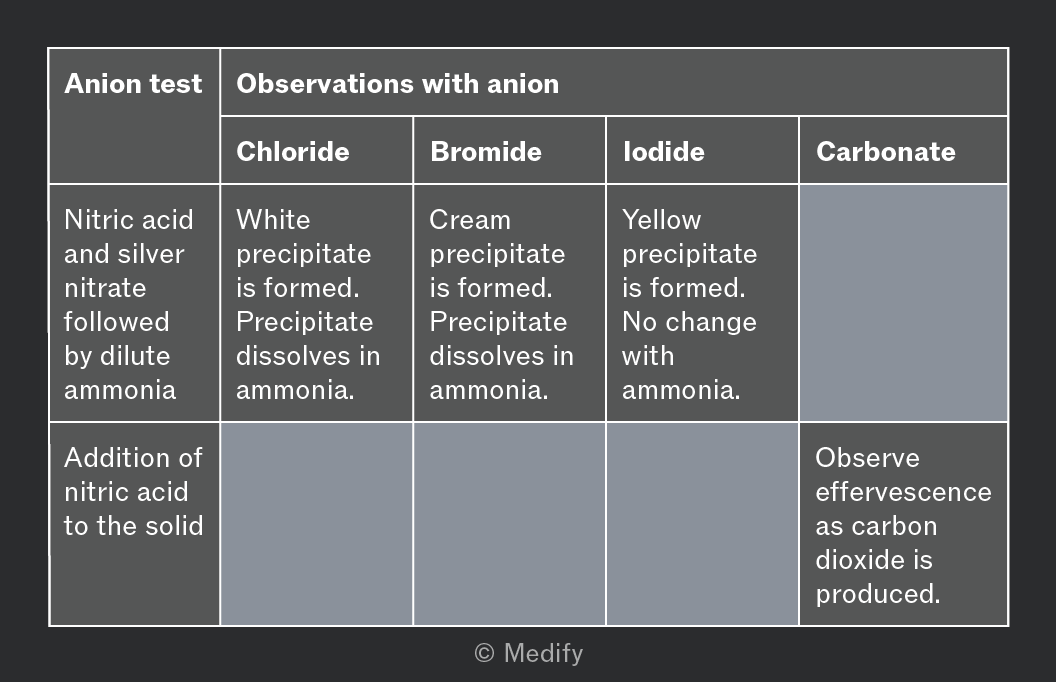
Below is a summary of the tests for anion tests and their observations from PAG 4.1:
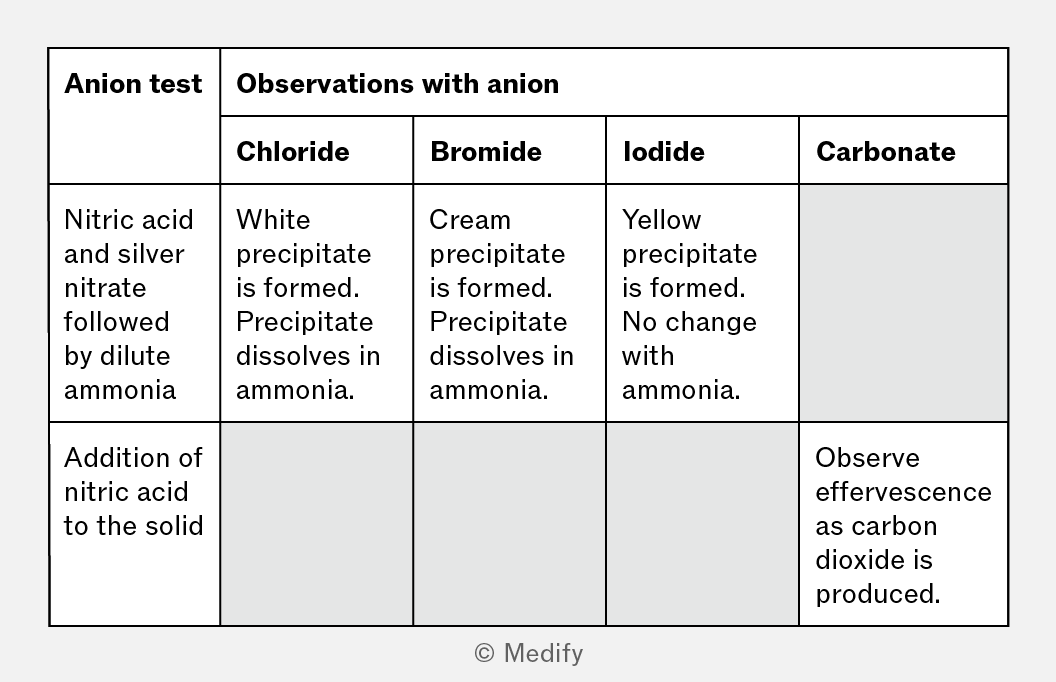
A table with two columns labeled 'Anion test' and 'Observations with anion'. Under 'Observations with anion', there are four sub-columns labeled 'Chloride', 'Bromide', 'Iodide', and 'Carbonate'. The first row under 'Anion test' states 'Nitric acid and silver nitrate followed by dilute ammonia'. Under 'Chloride', it reads 'White precipitate is formed. Precipitate dissolves in ammonia.' Under 'Bromide', it reads 'Cream precipitate is formed. Precipitate dissolves in ammonia.' Under 'Iodide', it reads 'Yellow precipitate is formed. No change with ammonia.' The 'Carbonate' column is empty. The second row under 'Anion test' states 'Addition of nitric acid to the solid'. The 'Chloride', 'Bromide', and 'Iodide' columns are empty, while the 'Carbonate' column reads 'Observe effervescence as carbon dioxide is produced.'
Add to favourites

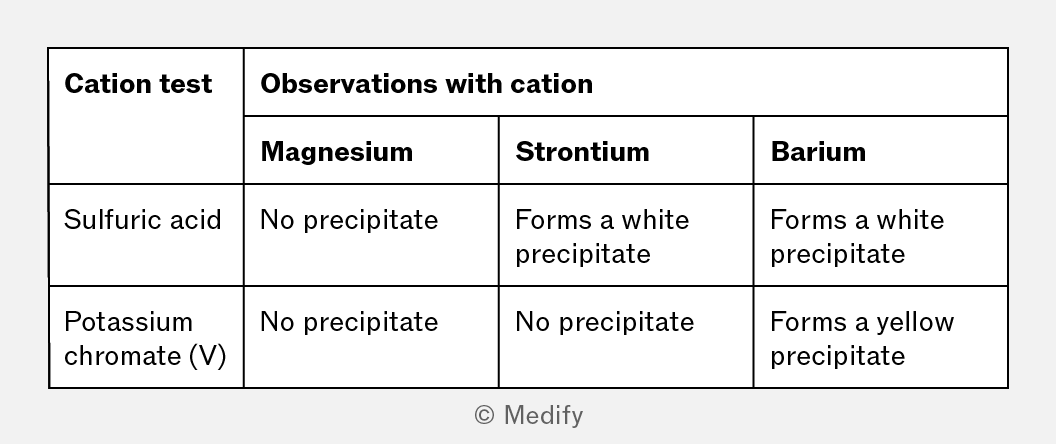
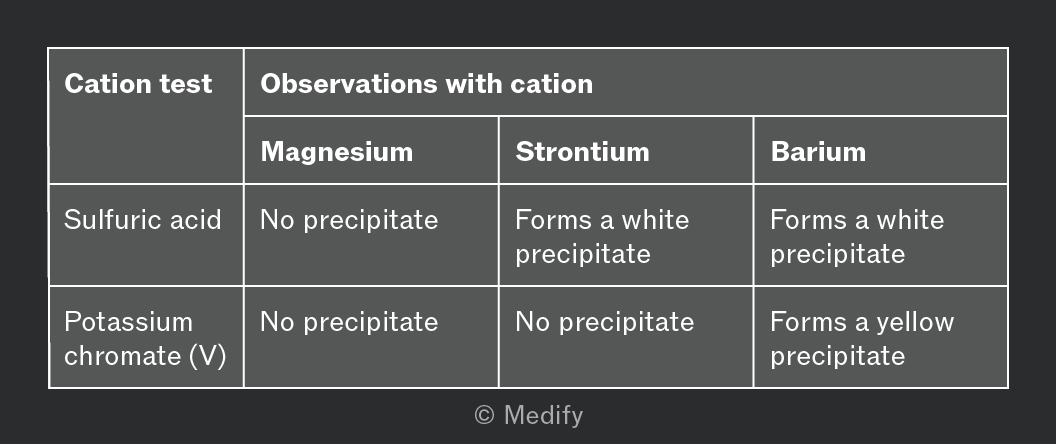
Below is a summary of the tests for cation tests and their observations from PAG 4.1:
A table with three columns under the heading 'Observations with cation' and two rows under the heading 'Cation test'. The columns are labeled 'Magnesium', 'Strontium', and 'Barium'. The rows are labeled 'Sulfuric acid' and 'Potassium chromate (V)'. Under 'Sulfuric acid', the observations are: 'No precipitate' for Magnesium, 'Forms a white precipitate' for Strontium, and 'Forms a white precipitate' for Barium. Under 'Potassium chromate (V)', the observations are: 'No precipitate' for both Magnesium and Strontium, and 'Forms a yellow precipitate' for Barium. © Medify is noted at the bottom.
Add to favourites