
PAG 10.1 - Rates – iodine clock
On this page
In OCR Chemistry Required Practical 10 (PAG 10.1), the rate of reaction for the iodine-clock reaction is measured using the initial rate method.
Peroxodisulfate(VI) ions, and iodide ions, react together in solution to form sulfate ions, and iodine,
The reaction is carried out in the presence of a fixed amount of aqueous thiosulfate ions, which reduces the iodine back to iodide and prevents the colour change.
When all the ions have been used up, the iodine will react with starch solution, producing a very rapid blue-black colour.
In OCR PAG 10.1: Rates – Iodine Clock, there are several important safety requirements to be aware of (beyond normal lab practice such as wearing goggles).
- Aqueous dipotassium peroxodisulfate may cause respiratory irritation – ensure the laboratory is well ventilated.
- Dispose of your chemicals as directed by your teacher.
Experimental method for OCR Chemistry Required Practical 10 (PAG 10.1)
![The image is a step-by-step guide for an experimental method labeled 'OCR PAG 10.1'. It includes five steps with illustrations and text. Step 1: Prepare five burettes with solutions: distilled water, 0.040 mol dm⁻³ Na2S2O8 (aq), 1% starch indicator solution, 1.00 mol dm⁻³ KI (aq), and 0.010 mol dm⁻³ Na2S2O3 (aq). Illustrations show burettes labeled KI, Starch, Water, S2O3²⁻, and S2O8²⁻. Step 2: Collect solutions for reactions according to a table. A table labeled 'Volume in cm³ of solution' includes columns for Exp, KI, Water, S2O3²⁻, Starch, and rows with volumes for experiments 1 to 5. Step 3: Collect S2O8²⁻ samples using small beakers to collect five 2.0 cm³ volumes. Step 4: Prepare a results table. The table labeled 'Prepare a results table' shows columns for Exp, KI cm³, Water cm³, [I⁻] in 10 cm³, Time (s), and rows for experiments 1 to 5. Step 5: Tip the S2O8²⁻ solution into one of the reaction beakers from step 1, record the time for the color change to dark blue. Illustrations show a beaker and a stopwatch reading 145 seconds. Repeat the reaction for other mixtures with a final table showing results for experiments 1 to 5, similar to the previous table.](https://d3nzlfkeryzt6j.cloudfront.net/ggp8o0n8uwg9tcv5r7wht72grw0w)
![The image is a step-by-step guide for an experimental method labeled 'OCR PAG 10.1'. It includes five steps with illustrations and text. Step 1: Prepare five burettes with solutions: distilled water, 0.040 mol dm⁻³ Na2S2O8 (aq), 1% starch indicator solution, 1.00 mol dm⁻³ KI (aq), and 0.010 mol dm⁻³ Na2S2O3 (aq). Illustrations show burettes labeled KI, Starch, Water, S2O3²⁻, and S2O8²⁻. Step 2: Collect solutions for reactions according to a table. A table labeled 'Volume in cm³ of solution' includes columns for Exp, KI, Water, S2O3²⁻, Starch, and rows with volumes for experiments 1 to 5. Step 3: Collect S2O8²⁻ samples using small beakers to collect five 2.0 cm³ volumes. Step 4: Prepare a results table. The table labeled 'Prepare a results table' shows columns for Exp, KI cm³, Water cm³, [I⁻] in 10 cm³, Time (s), and rows for experiments 1 to 5. Step 5: Tip the S2O8²⁻ solution into one of the reaction beakers from step 1, record the time for the color change to dark blue. Illustrations show a beaker and a stopwatch reading 145 seconds. Repeat the reaction for other mixtures with a final table showing results for experiments 1 to 5, similar to the previous table.](https://d3nzlfkeryzt6j.cloudfront.net/w495etjyvy8or2lu57meryfez7gc)
Clean, dry glassware should always be used in any experiment where concentration is important.
Accurately measuring time is essential in rate investigations.


The fixed thiosulfate concentration means the blue-black colour appears after a fixed amount of iodine has formed.
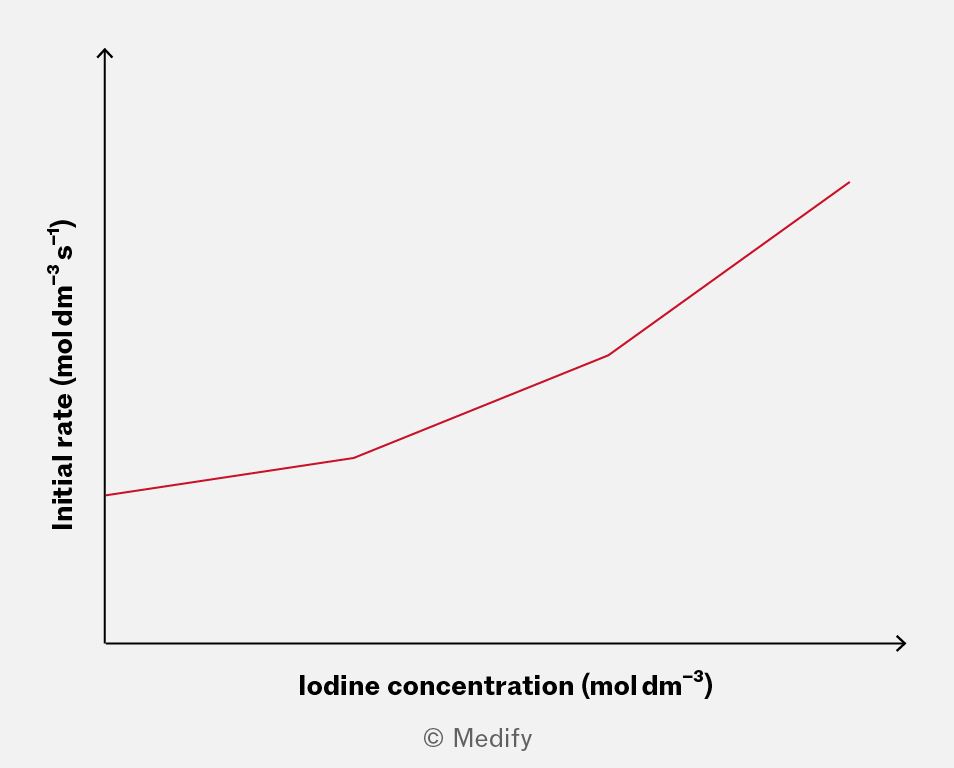
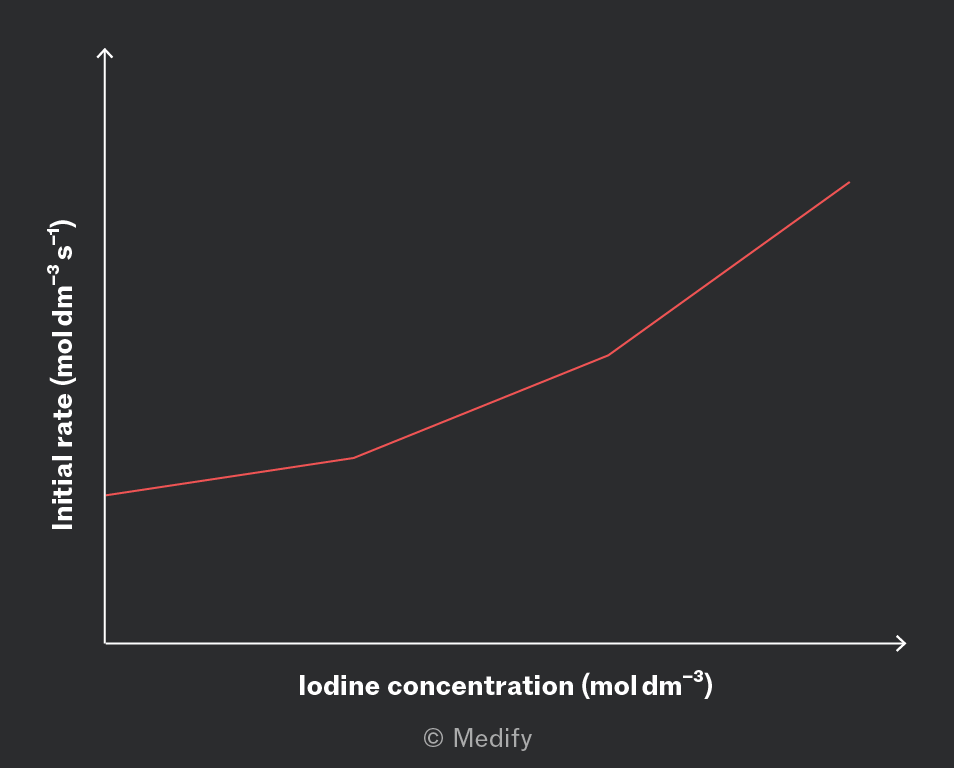
Use initial rate = fixed change in ÷ time, then plot initial rate against to determine the order.
Calculate the rate constant using the relationship: