
PAG 10.2 - Rates – thiosulfate and acid
On this page
In OCR Chemistry Required Practical 10 (PAG 10.2), rate of reaction is measured using the initial rate method. The reaction between aqueous thiosulfate ions, and aqueous acid, is often called the disappearing cross reaction.
The rate of this reaction can be followed by observing the time taken for precipitation of sulfur. We can vary the concentration of both reactants to investigate how they affect this.
In OCR PAG 10.2: Rates – Thiosulfate and acid, there are several important safety requirements to be aware of (beyond normal lab practice such as wearing goggles).
- Dispose of chemicals as directed by your teacher.
- Sulfur dioxide is produced and can cause respiratory issues – ensure the laboratory is well ventilated.
Experimental method for OCR Chemistry Required Practical 10 – Part 1 (PAG 10.2) – The effect of changing the concentration of thiosulfate ions.
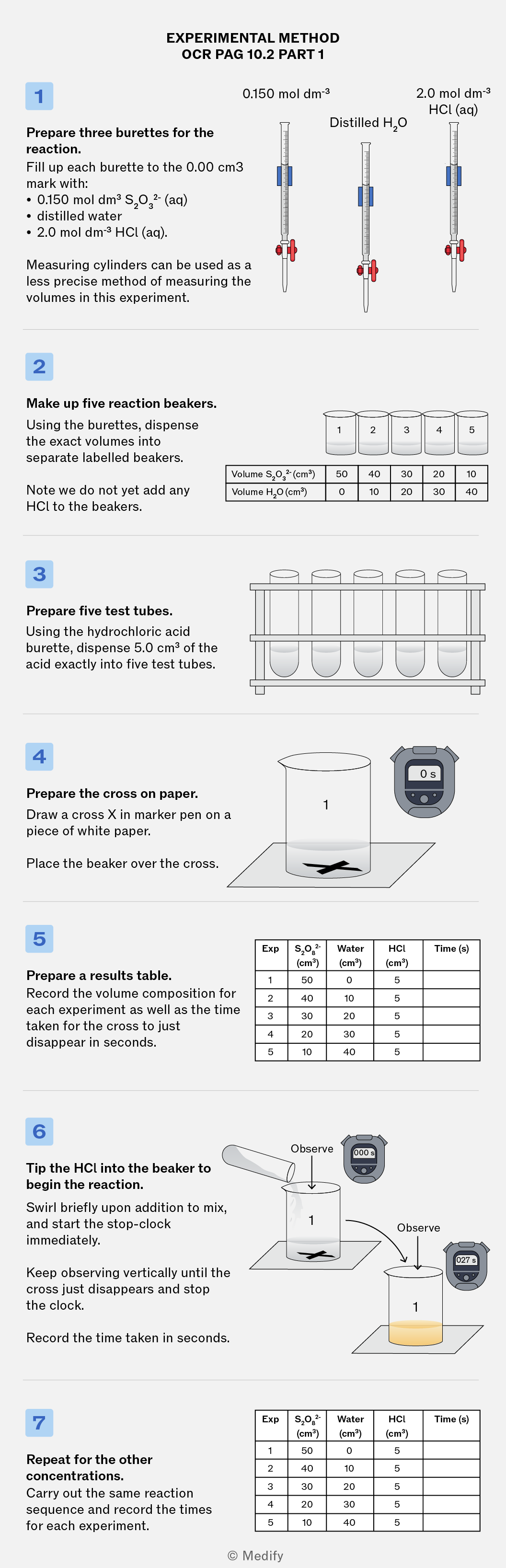
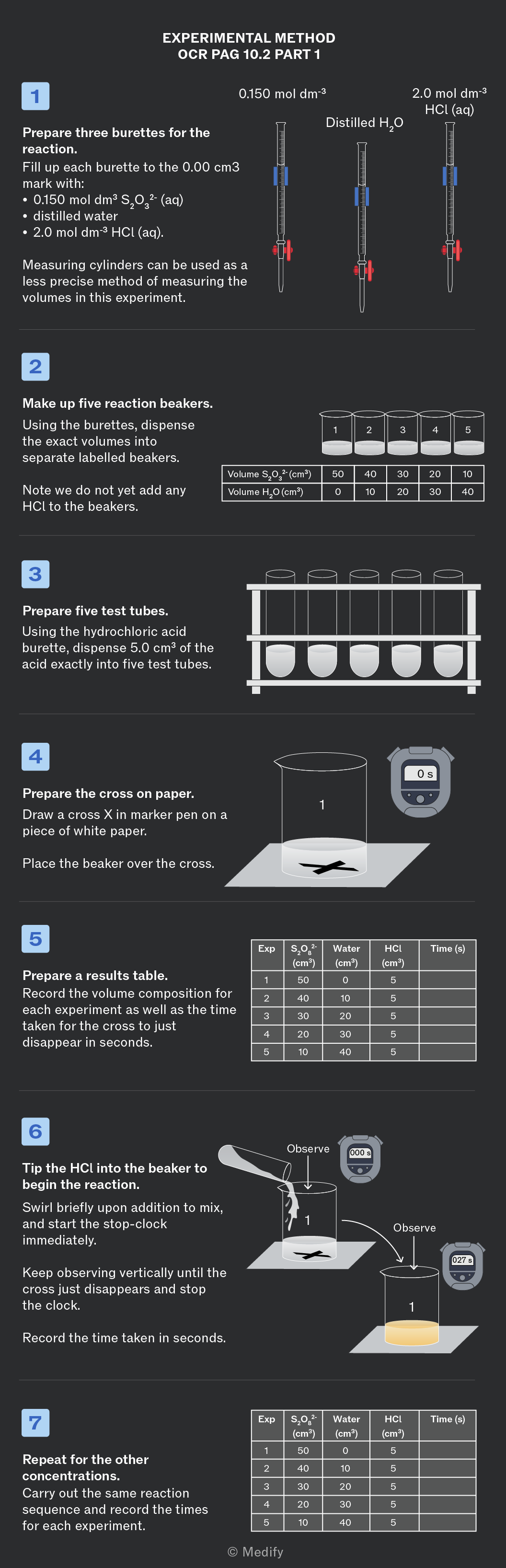
Experimental method for OCR Chemistry Required Practical 10 – Part 1 (PAG 10.2) – The effect of changing the concentration of ions.
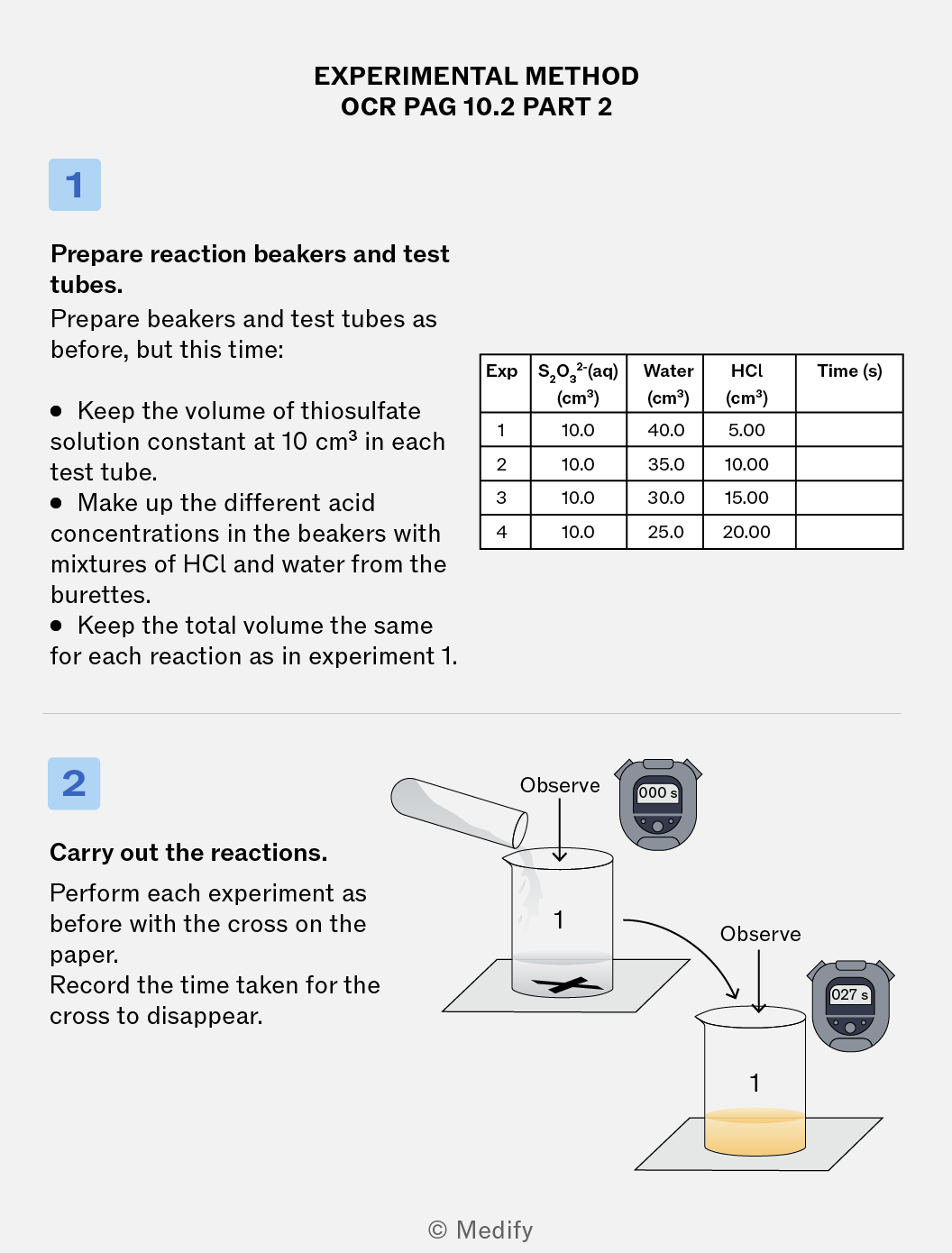
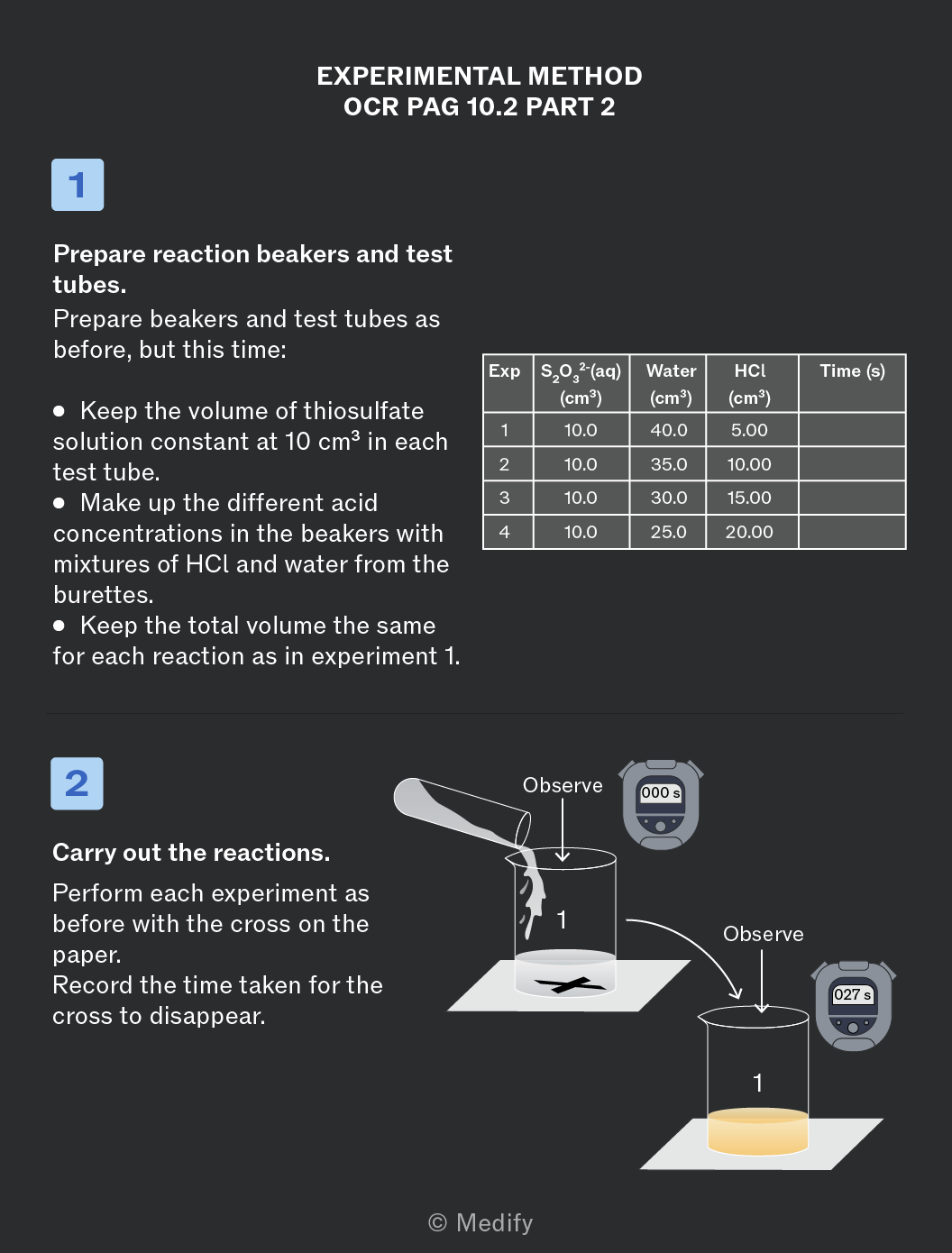
Clean, dry glassware should always be used in any experiment where concentration is important.



Accurately measuring time is essential in rate investigations.




Calculate the initial rate for each experiment using:
Plot two graphs of initial rate against and and use the shape of each graph to determine the reaction order with respect to each reactant.
![A graph with the x-axis labeled '[S2O3^2-] (mol dm^-3)' and the y-axis labeled 'Initial rate 1/t (s^-1)'. The graph shows a red line with a positive slope, indicating an increase. There are no visible numeric axis values or plotted markers on the graph. The line starts near the origin and moves upwards to the right.](https://d3nzlfkeryzt6j.cloudfront.net/cw81h5tlcz8n3lquwhthzb8fp3zq)
![A graph with the x-axis labeled '[S2O3^2-] (mol dm^-3)' and the y-axis labeled 'Initial rate 1/t (s^-1)'. The graph shows a red line with a positive slope, indicating an increase. There are no visible numeric axis values or plotted markers on the graph. The line starts near the origin and moves upwards to the right.](https://d3nzlfkeryzt6j.cloudfront.net/4m3sc6zenqdzelnr99mnnn1v3bhl)
Use these orders to propose the rate equation.
For the graph, calculate the gradient of the best-fit line to obtain a value proportional to the rate constant.