Module 1: Practical chemistry for exams›PAG 8.1 - Electrochemical cells 1

PAG 8.1 - Electrochemical cells 1

An overview of PAG 8.1 - Electrochemical cells 1
2 min

In OCR Chemistry Required Practical 8 (PAG 8.1 ), the effect of concentration changes on the value of the EMF of a copper and iron cell is investigated.

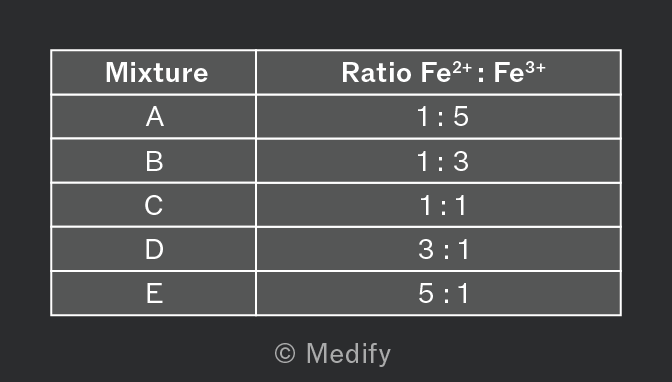
Five different ratios of iron ions are used in the experiment.
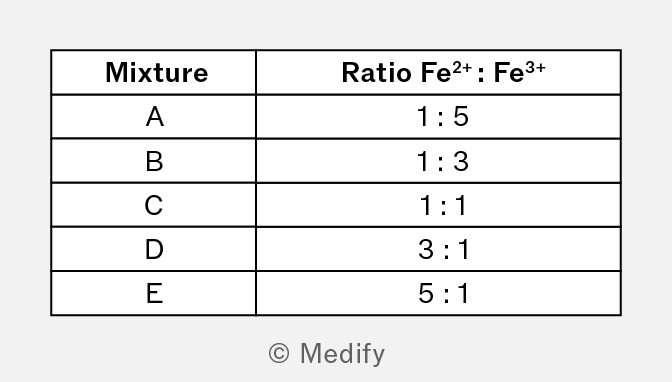
A table displaying mixtures and their corresponding ratios of Fe2+ to Fe3+. The table includes the following entries: Mixture A with a ratio of 1 : 5, Mixture B with a ratio of 1 : 3, Mixture C with a ratio of 1 : 1, Mixture D with a ratio of 3 : 1, and Mixture E with a ratio of 5 : 1.
Add to favourites

In OCR PAG 8.1: Electrochemical cells 1, there are several important safety requirements to be aware of (beyond normal lab practice such as wearing goggles).

  • Dispose of chemicals as directed by your teacher.
Add to favourites

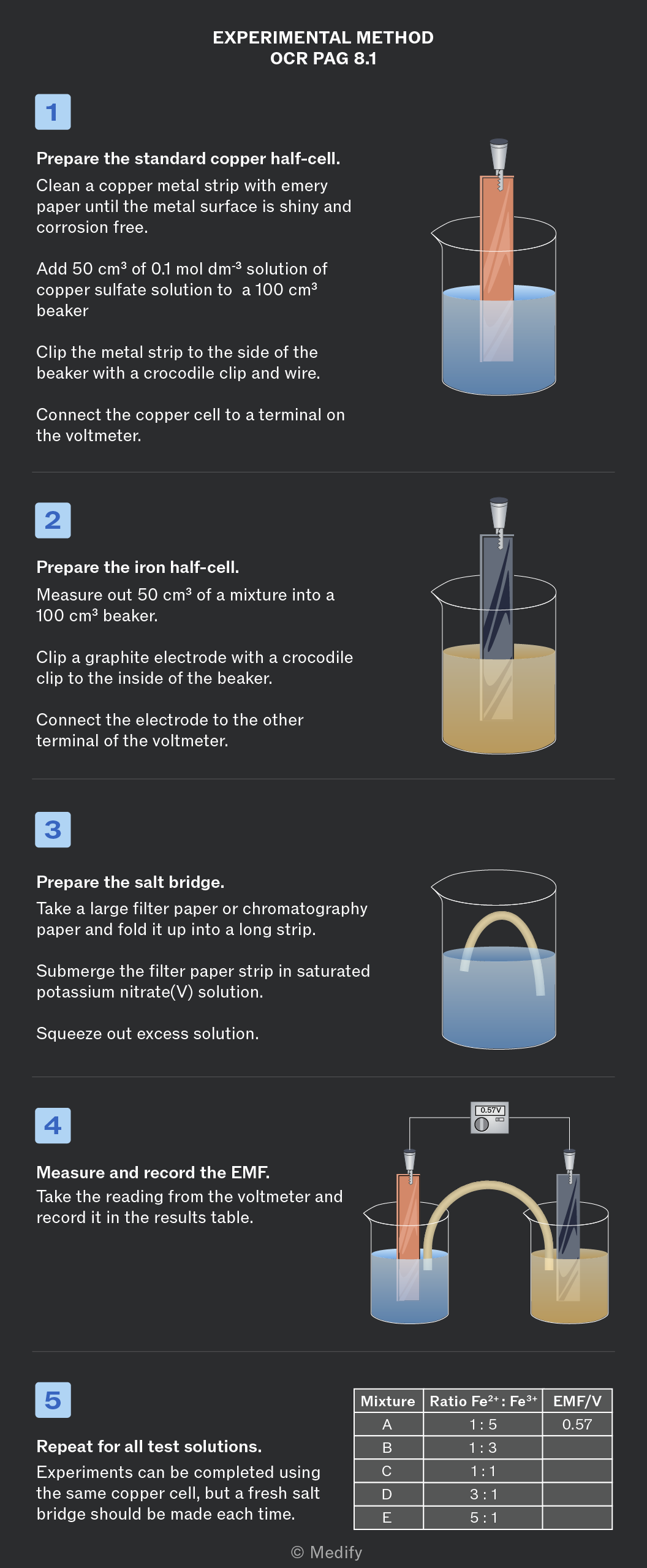
Experimental method for OCR Chemistry Required Practical 8 (PAG 8.1)
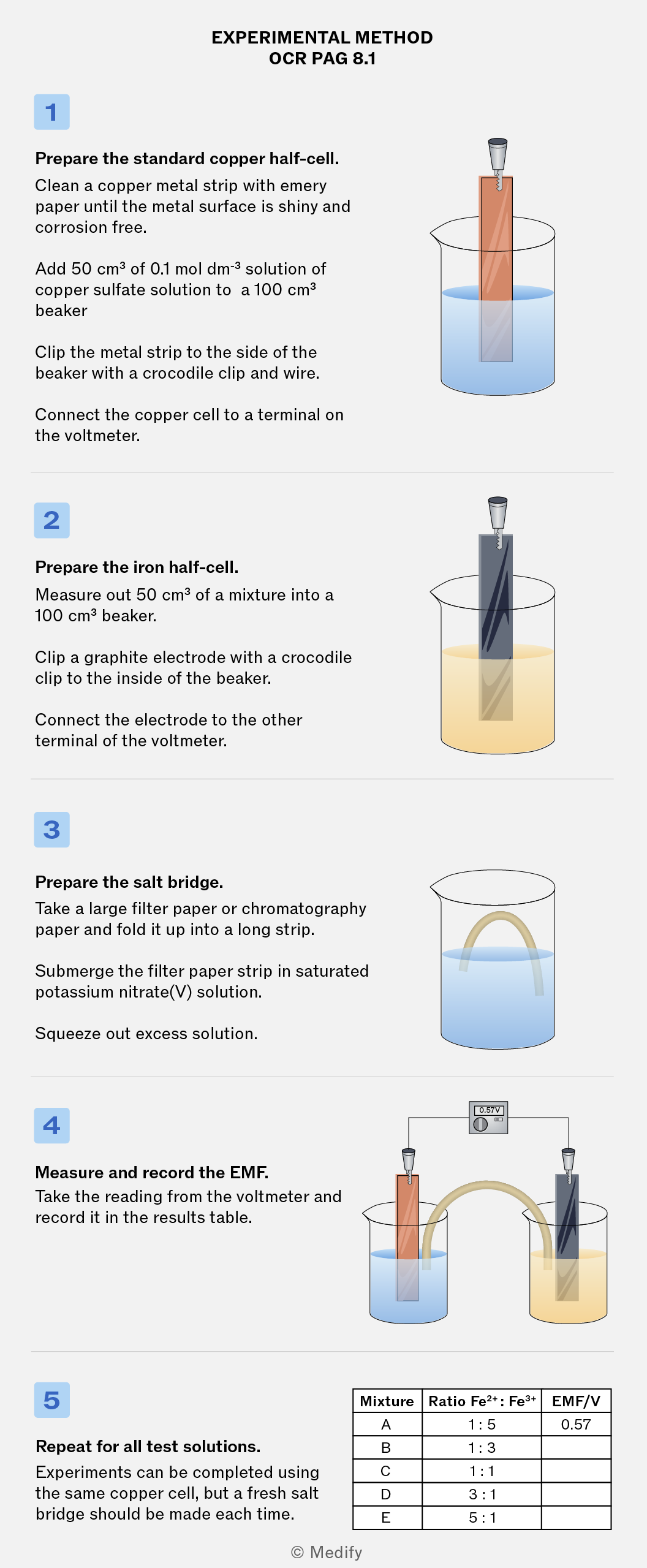
EXPERIMENTAL METHOD OCR PAG 8.1 1 Prepare the standard copper half-cell. Clean a copper metal strip with emery paper until the metal surface is shiny and corrosion free. Add 50 cm3 of 0.1 mol dm-3 solution of copper sulfate solution to a 100 cm3 beaker. Clip the metal strip to the side of the beaker with a crocodile clip and wire. Connect the copper cell to a terminal on the voltmeter. 2 Prepare the iron half-cell. Measure out 50 cm3 of a mixture into a 100 cm3 beaker. Clip a graphite electrode with a crocodile clip to the inside of the beaker. Connect the electrode to the other terminal of the voltmeter. 3 Prepare the salt bridge. Take a large filter paper or chromatography paper and fold it up into a long strip. Submerge the filter paper strip in saturated potassium nitrate(V) solution. Squeeze out excess solution. 4 Measure and record the EMF. Take the reading from the voltmeter and record it in the results table. 5 Repeat for all test solutions. Experiments can be completed using the same copper cell, but a fresh salt bridge should be made each time. Mixture Ratio Fe2+: Fe3+ EMF/V A 1:5 0.57 B 1:3 C 1:1 D 3:1 E 5:1
Add to favourites

To ensure clean and reactive metal surfaces when preparing an electrode for accurate voltage readings.


A vertical rectangular shape with a gradient fill transitioning from a darker orange at the top to a lighter orange at the bottom, outlined in black.
Do

Clean all metal surfaces thoroughly with emery paper and degrease with propanone to remove oxide layers and grease.

A rectangular shape with a smooth, gradient orange surface, resembling a piece of caramel or toffee.
Don't

Skip the cleaning or degreasing step – this increases surface resistance and affects the EMF value.

Add to favourites

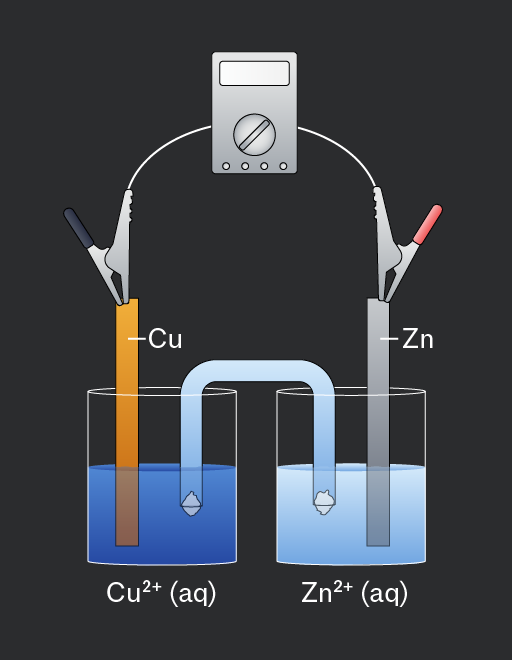
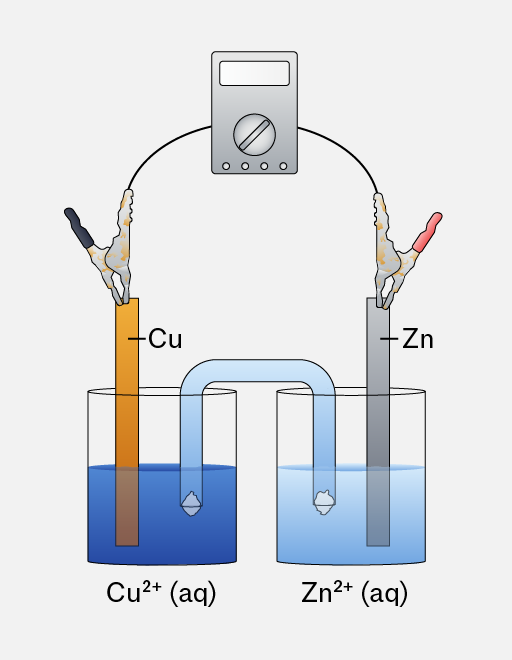
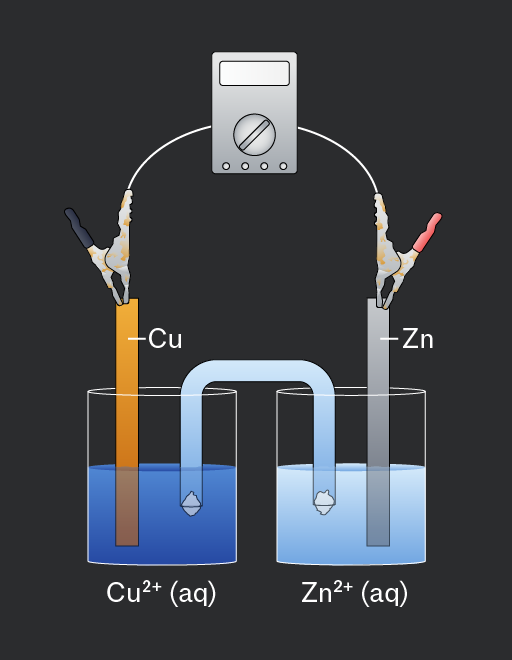
It is important to have strong connections between half cells.
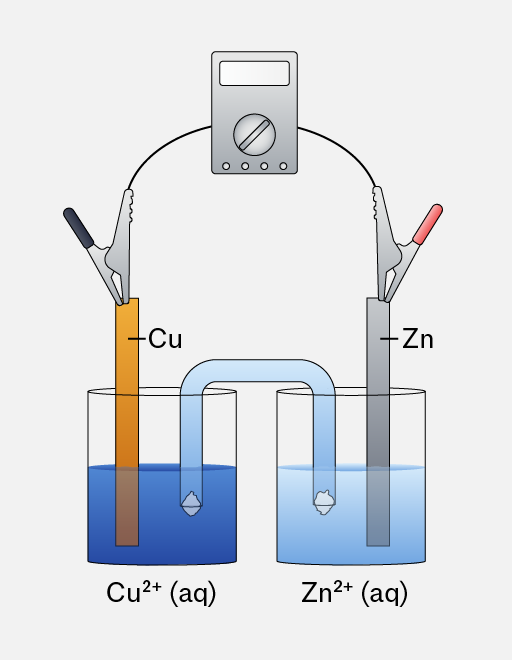
An illustration showing two beakers connected by a tube. The left beaker contains a copper electrode labeled 'Cu' and a solution labeled 'Cu2+ (aq)', while the right beaker contains a zinc electrode labeled 'Zn' and a solution labeled 'Zn2+ (aq)'. A voltmeter is connected to both electrodes.
Do

Ensure firm connections between metal electrodes and the voltmeter using crocodile clips, checking for a stable reading.

An illustration showing a setup with two beakers containing Cu2+ (aq) and Zn2+ (aq) solutions. A copper rod labeled 'Cu' is immersed in the left beaker, while a zinc rod labeled 'Zn' is in the right beaker. A voltmeter is connected to both rods with alligator clips.
Don't

Allow loose or corroded connections – these can cause unstable or fluctuating voltage readings.

Add to favourites

Use the voltage results to identify the electrode reactions:

and giving

Compare the voltages for the different ratios.

As decreases, the electrode potential becomes less positive and decreases.

Add to favourites