Module 1: Practical chemistry for exams›PAG 8.3 - Electrochemical cells 3 (microscale)

PAG 8.3 - Electrochemical cells 3 (microscale)

An overview of PAG 8.3 - Electrochemical cells 3 (microscale)
1 min

In OCR Chemistry Required Practical 8 (PAG 8.3 ), a series of microscale half-cells are produced from metals and solutions of their ions. EMF values are obtained for different combinations of half-cells.

Half-cells to be tested are:

Add to favourites

In OCR PAG 8.3: Electrochemical cells 3, normal lab practice such as wearing goggles is adequate when carrying out the practical steps.

Add to favourites

Experimental method for OCR Chemistry Required Practical 8 (PAG 8.3)
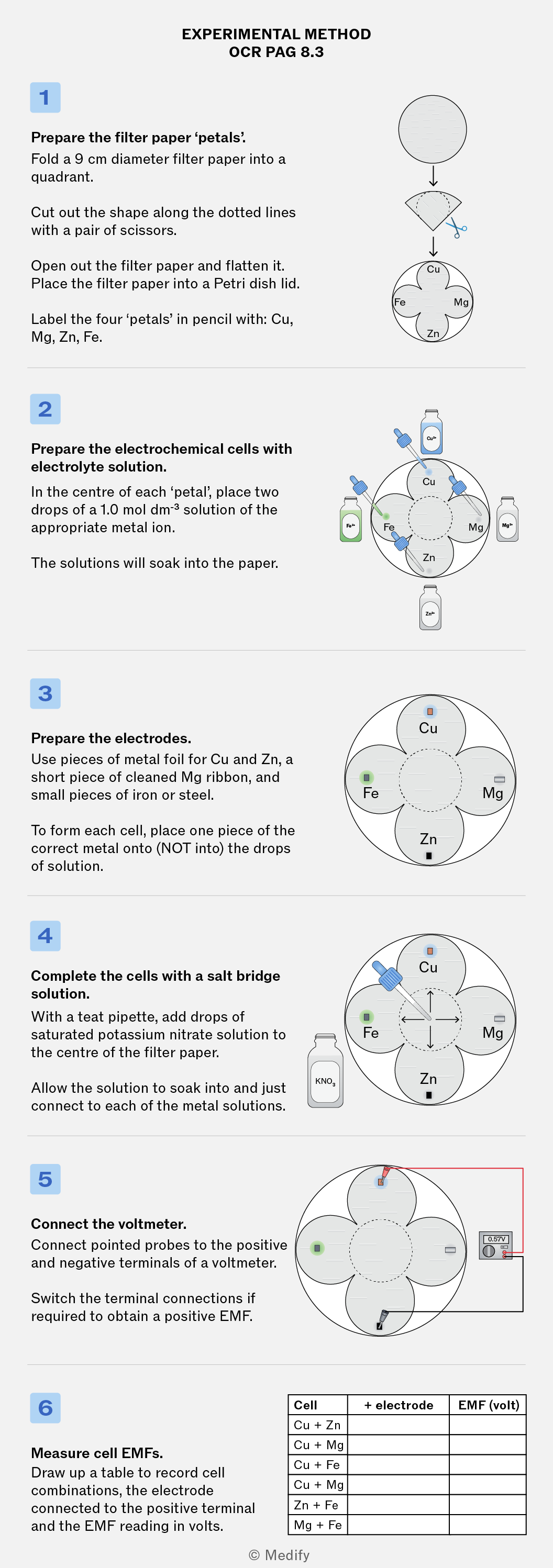
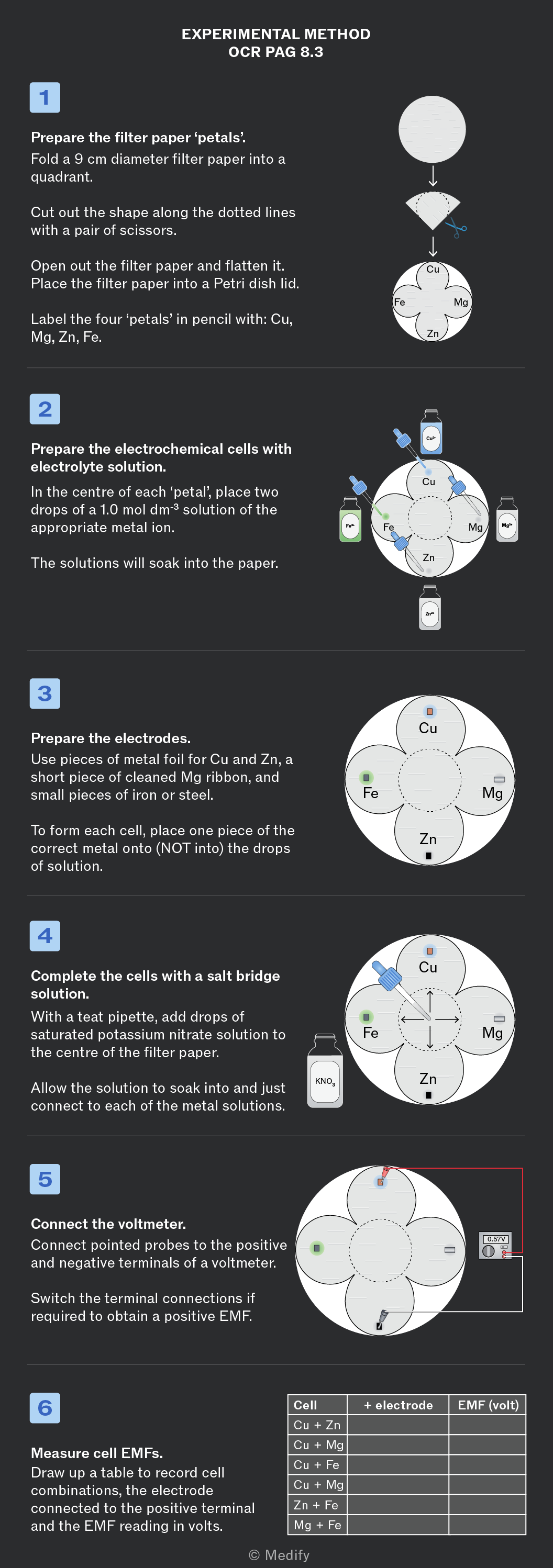
EXPERIMENTAL METHOD OCR PAG 8.3. 1. Prepare the filter paper ‘petals’. Fold a 9 cm diameter filter paper into a quadrant. Cut out the shape along the dotted lines with a pair of scissors. Open out the filter paper and flatten it. Place the filter paper into a Petri dish lid. Label the four ‘petals’ in pencil with: Cu, Mg, Zn, Fe. 2. Prepare the electrochemical cells with electrolyte solution. In the centre of each ‘petal’, place two drops of a 1.0 mol dm-3 solution of the appropriate metal ion. The solutions will soak into the paper. 3. Prepare the electrodes. Use pieces of metal foil for Cu and Zn, a small pieces of iron or steel. To form each cell, place one piece of the correct metal onto (NOT into) the drops of solution. 4. Complete the cells with a salt bridge solution. With a teat pipette, add drops of saturated potassium nitrate solution to the centre of the paper. Allow the solution to soak into and just connect to each of the metal solutions. 5. Connect the voltmeter. Connect pointed probes to the positive and negative terminals of a voltmeter. Switch the terminal connections if required to obtain a positive EMF. 6. Measure cell EMFs. Draw up a table to record cell combinations, the electrode connected to the positive terminal and the EMF reading in volts.
Add to favourites

Calculate the expected potential and compare with the measured values for each cell using:

The more negative half-cell is oxidised and the more positive half-cell reduced. Combine the half-equations to give the overall reaction, e.g.

Add to favourites