Module 1: Practical chemistry for exams›PAG 9.2 - The rate of reaction of calcium carbonate and hydrochloric acid

PAG 9.2 - The rate of reaction of calcium carbonate and hydrochloric acid

An overview of PAG 9.2 - The rate of reaction of calcium carbonate and hydrochloric acid
4 min

In OCR Chemistry Required Practical 9 (PAG 9.2), the rate of a reaction is measured using the continuous monitoring method.

Marble chips (in excess) will be reacted with hydrochloric acid as in the equation:

Data on the change of mass over time is collected as marble chips react with hydrochloric acid, releasing carbon dioxide gas. The same experiment is also completed via gas collection, using a graduated gas syringe to measure volume produced over time.

From this data, the order of the reaction with respect to can be determined.

Add to favourites

In OCR PAG 9.2: The rate of reaction of calcium carbonate and hydrochloric acid, normal lab practice such as wearing goggles is adequate when carrying out the practical steps.

Add to favourites

Experimental method for OCR Chemistry Required Practical 9 (PAG 9.2)

Part 1: Measurement of reaction rate using mass loss over time
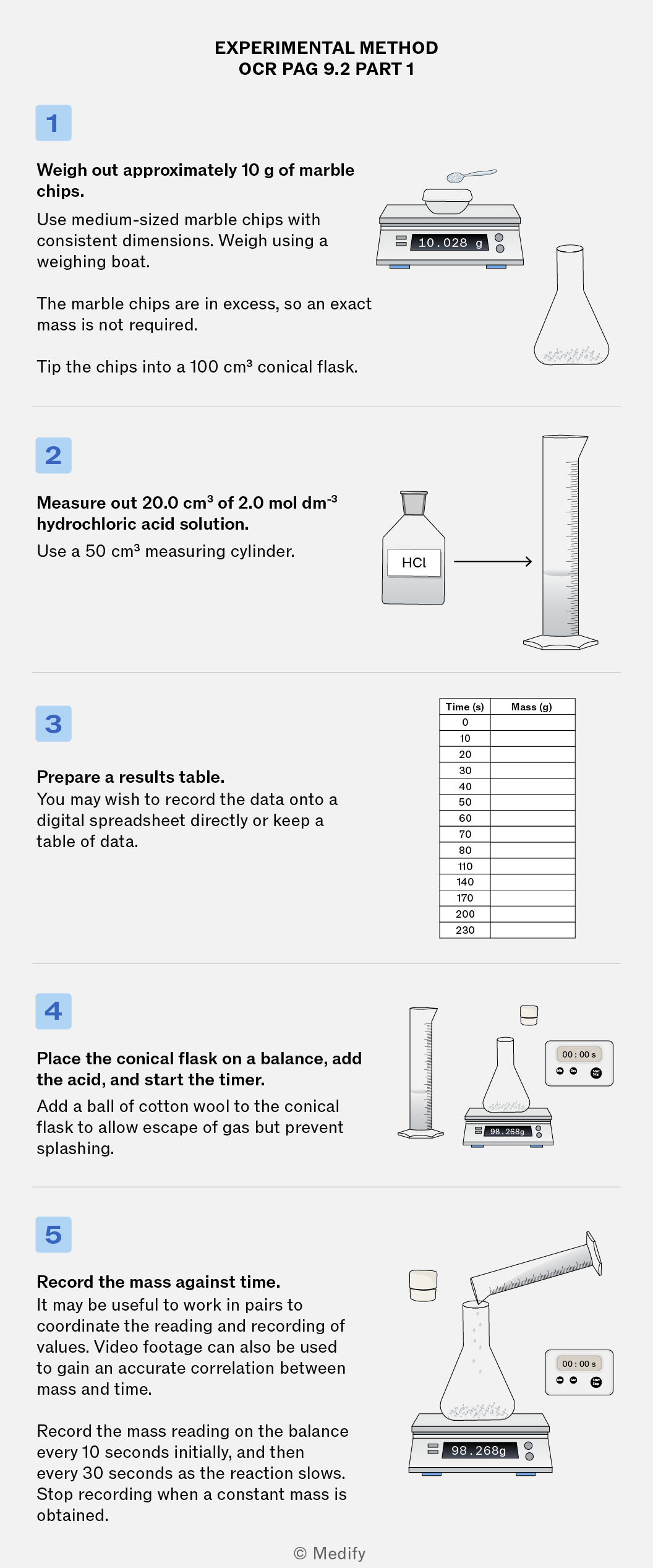
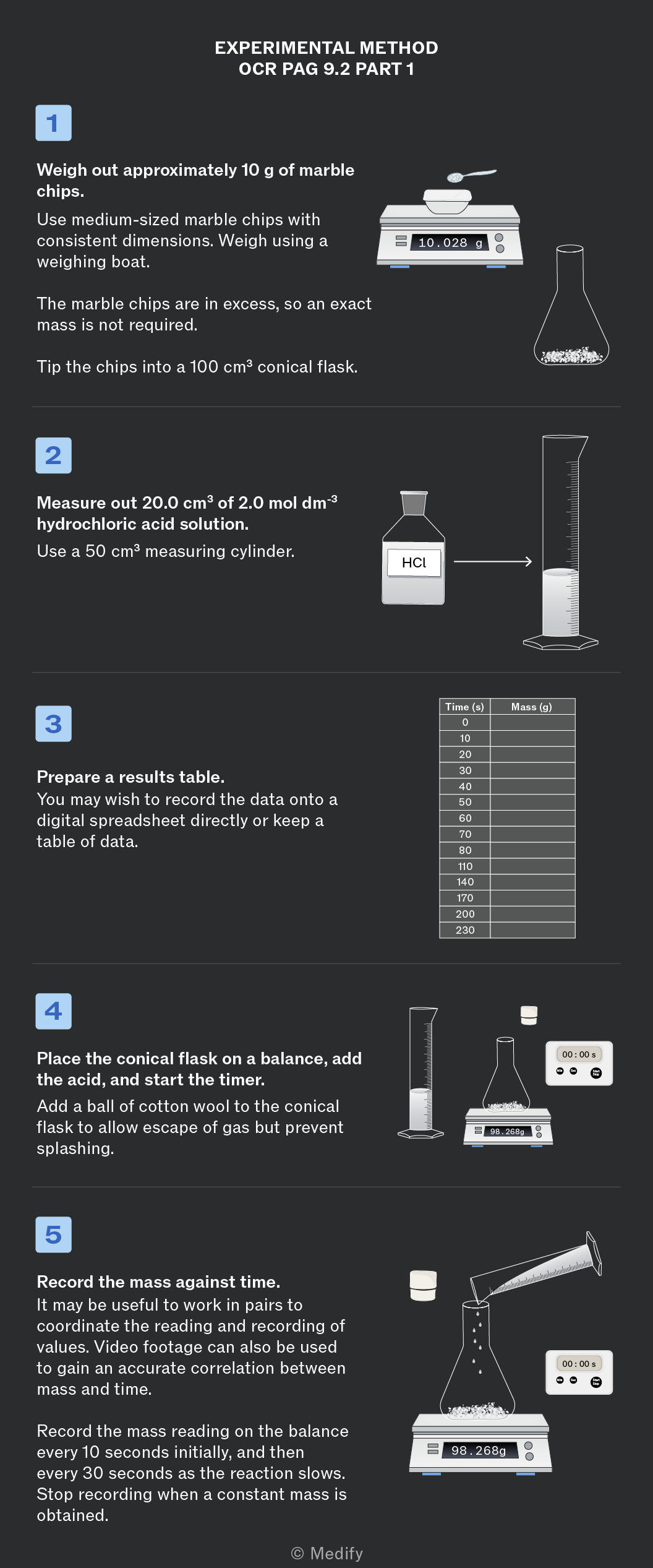
EXPERIMENTAL METHOD OCR PAG 9.2 PART 1. 1. Weigh out approximately 10 g of marble chips. Use medium-sized marble chips with consistent dimensions. Weigh using a weighing boat. The marble chips are in excess, so an exact mass is not required. Tip the chips into a 100 cm3 conical flask. 2. Measure out 20.0 cm3 of 2.0 mol dm-3 hydrochloric acid solution. Use a 50 cm3 measuring cylinder. 3. Prepare a results table. You may wish to record the data onto a digital spreadsheet directly or keep a table of data. 4. Place the conical flask on a balance, add the acid, and start the timer. Add a ball of cotton wool to the conical flask to allow escape of gas but prevent splashing. 5. Record the mass against time. It may be useful to work in pairs to coordinate the reading and recording of values. Video footage can also be used to gain an accurate correlation between mass and time. Record the mass reading on the balance every 10 seconds initially, and then every 30 seconds as the reaction slows. Stop recording when a constant mass is obtained.
Add to favourites

Experimental method for OCR Chemistry Required Practical 9 (PAG 9.2)

Part 2: Measurement of reaction rate using gas production over time.
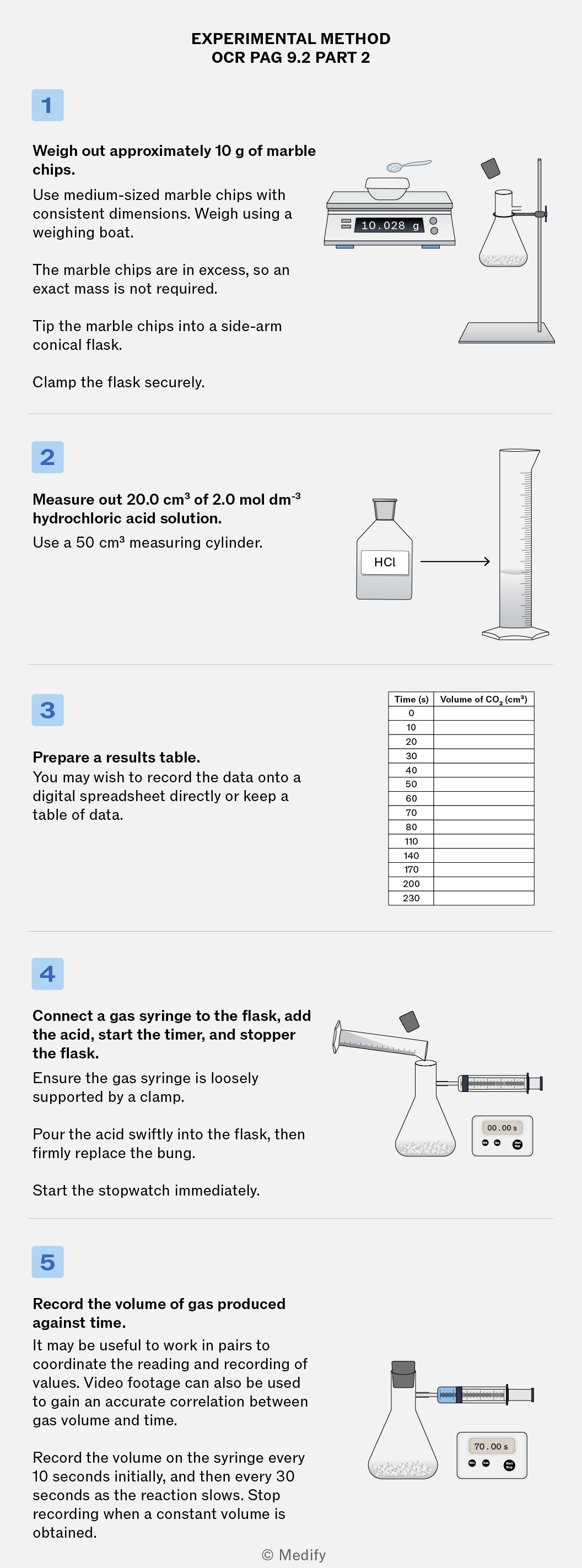
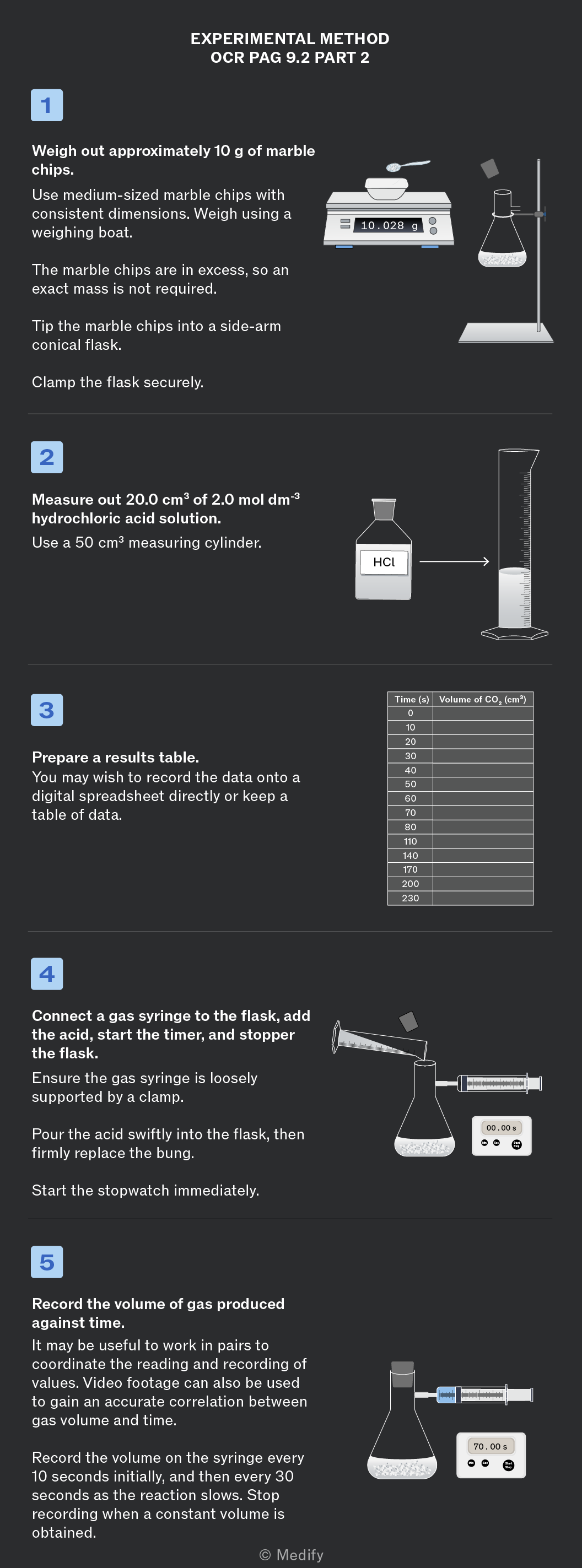
EXPERIMENTAL METHOD OCR PAG 9.2 PART 2. 1. Weigh out approximately 10 g of marble chips. Use medium-sized marble chips with consistent dimensions. Weigh using a weighing boat. The marble chips are in excess, so an exact mass is not required. Tip the marble chips into a side-arm conical flask. Clamp the flask securely. 2. Measure out 20.0 cm³ of 2.0 mol dm⁻³ hydrochloric acid solution. Use a 50 cm³ measuring cylinder. 3. Prepare a results table. You may wish to record the data onto a digital spreadsheet directly or keep a table of data. 4. Connect a gas syringe to the flask, add the acid, start the timer, and stopper the flask. Ensure the gas syringe is loosely supported by a clamp. Pour the acid swiftly into the flask, then firmly replace the bung. Start the stopwatch immediately. 5. Record the volume of gas produced against time. It may be useful to work in pairs to coordinate the reading and recording of values. Video footage can also be used to gain an accurate correlation between gas volume and time. Record the volume on the syringe every 10 seconds initially, and then every 30 seconds as the reaction slows. Stop recording when a constant volume is obtained. © Medify
Add to favourites

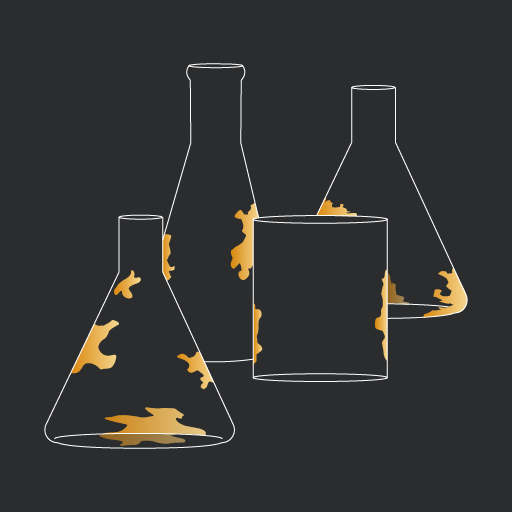
Clean, dry glassware should always be used in any experiment where concentration is important.
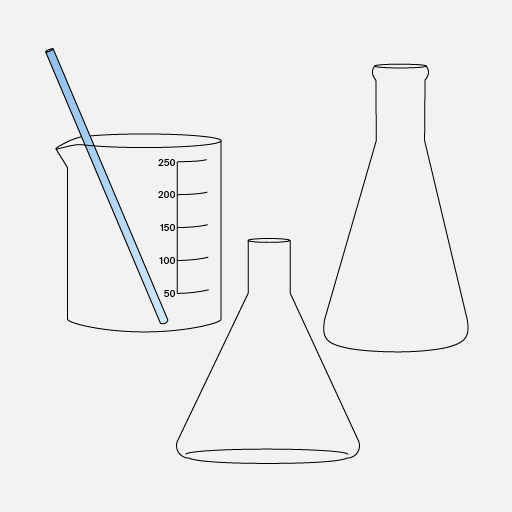
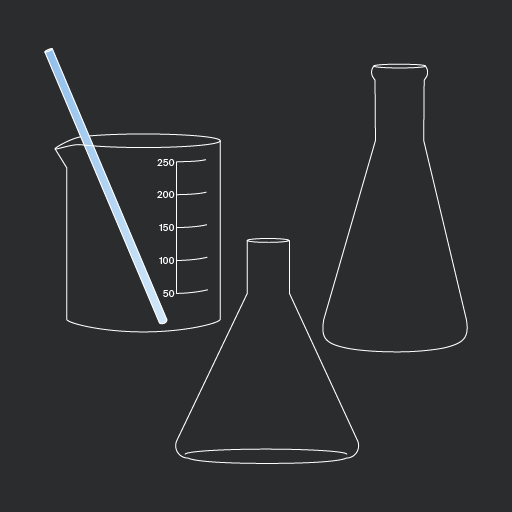
An illustration showing a graduated beaker with a blue stirring rod, a round-bottom flask, and a conical flask.
Do

Ensure glassware is clean and dry before use to prevent dilution or unwanted reactions.

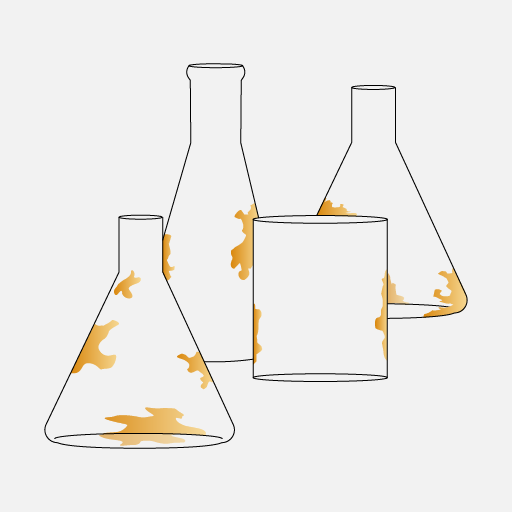
Four laboratory glassware pieces, including two conical flasks, one round-bottom flask, and one beaker, all featuring orange stains.
Don't

Use wet or contaminated glassware – this can affect concentrations and skew results. Rinsing with distilled water directly prior to use is not appropriate here.

Add to favourites

Accurately measuring time is essential in rate investigations.
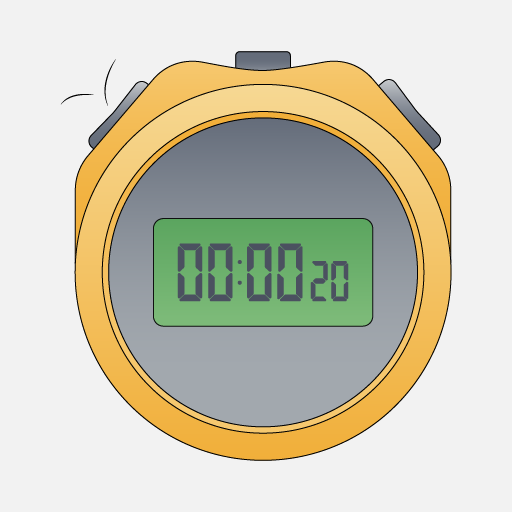
A round yellow stopwatch displaying the time 00:00:20 on a green digital screen.
Do

Start timing immediately after mixing reagents to ensure an accurate measurement of the reaction rate.

A round yellow stopwatch displaying the word 'ERROR' in large green letters on its screen.
Don't

Stop the timer to take measurements. The reaction hasn’t stopped, so neither should the timer.

Add to favourites

Plot mass against time for the mass-loss method, use the results to determine successive half-lives and hence the order with respect to
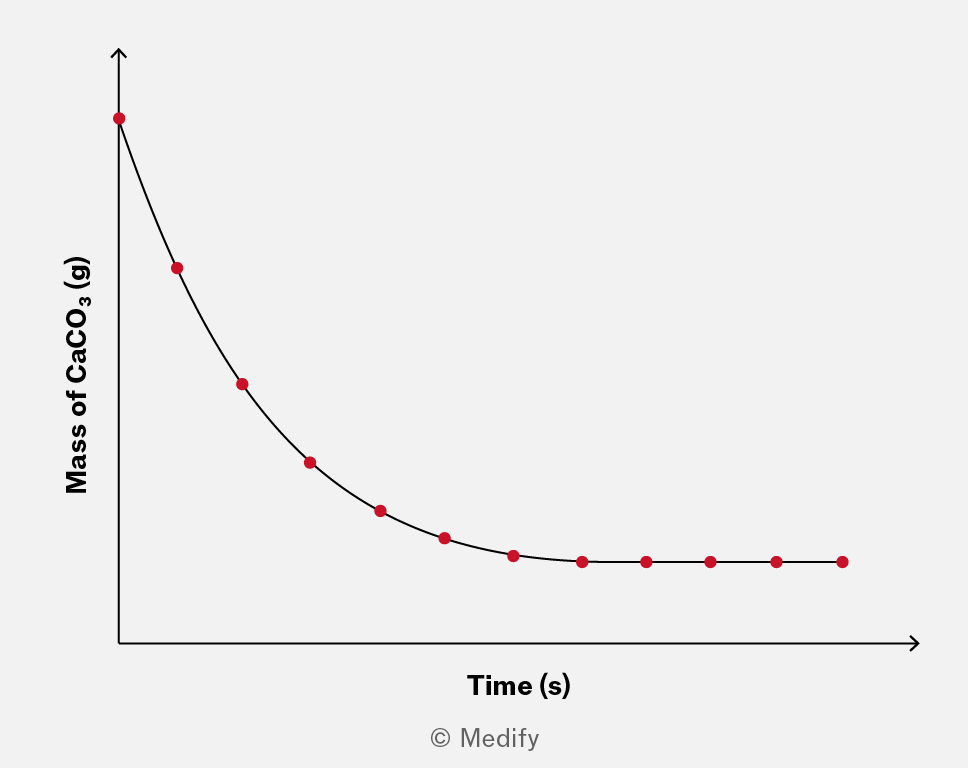
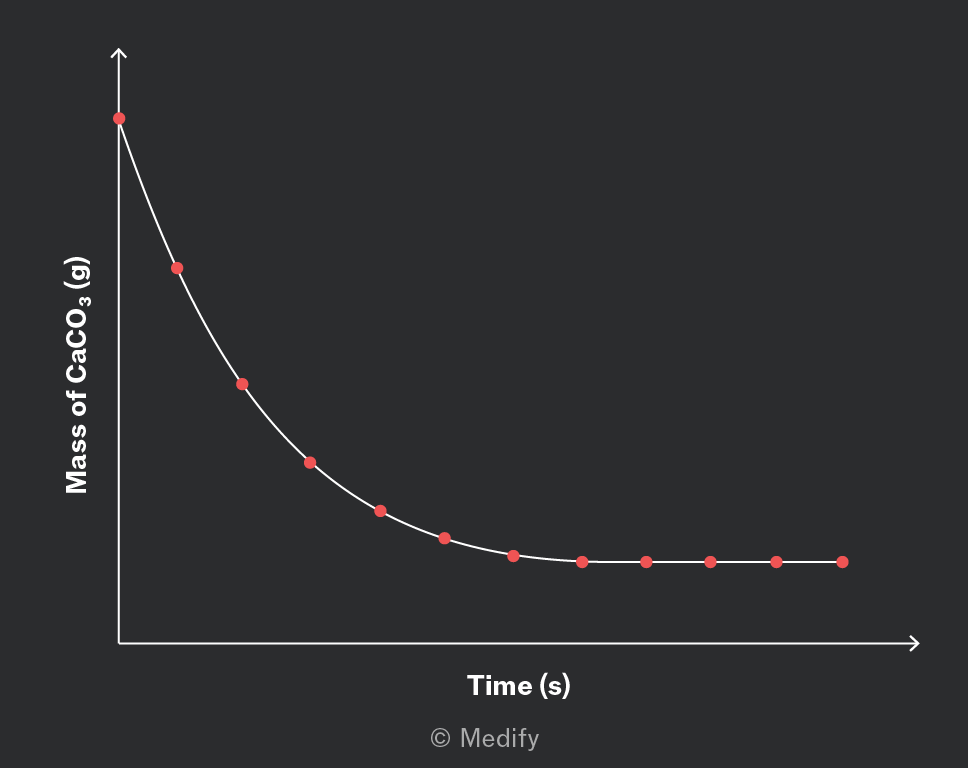
A graph with the x-axis labeled 'Time (s)' and the y-axis labeled 'Mass of CaCO3 (g)'. The graph shows a downward curve with plotted red markers along the line. The curve starts high on the y-axis and gradually levels off as it moves to the right. The visible markers indicate specific data points along the curve, showing a decrease in mass over time. No specific numerical values are visible on the axes. The graph is annotated with '© Medify' at the bottom.
Add to favourites

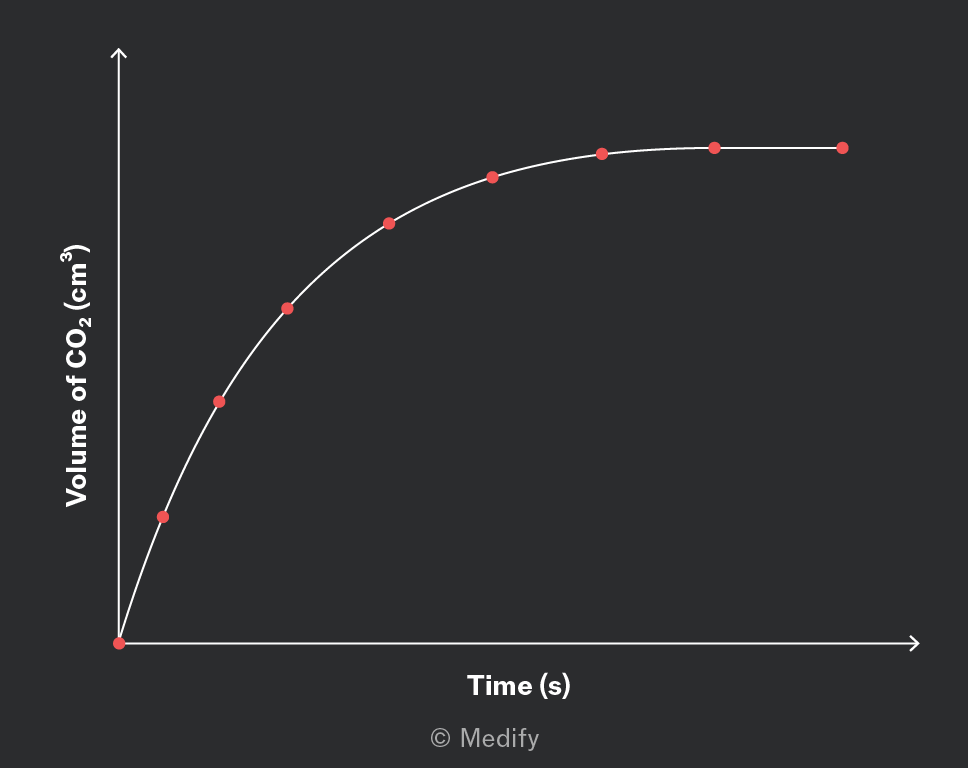
Use the volume of collected to calculate the concentration of remaining at each time using:

Plot against time and use the graph to determine three successive half-lives.

Compare the half-lives to determine the order of reaction with respect to
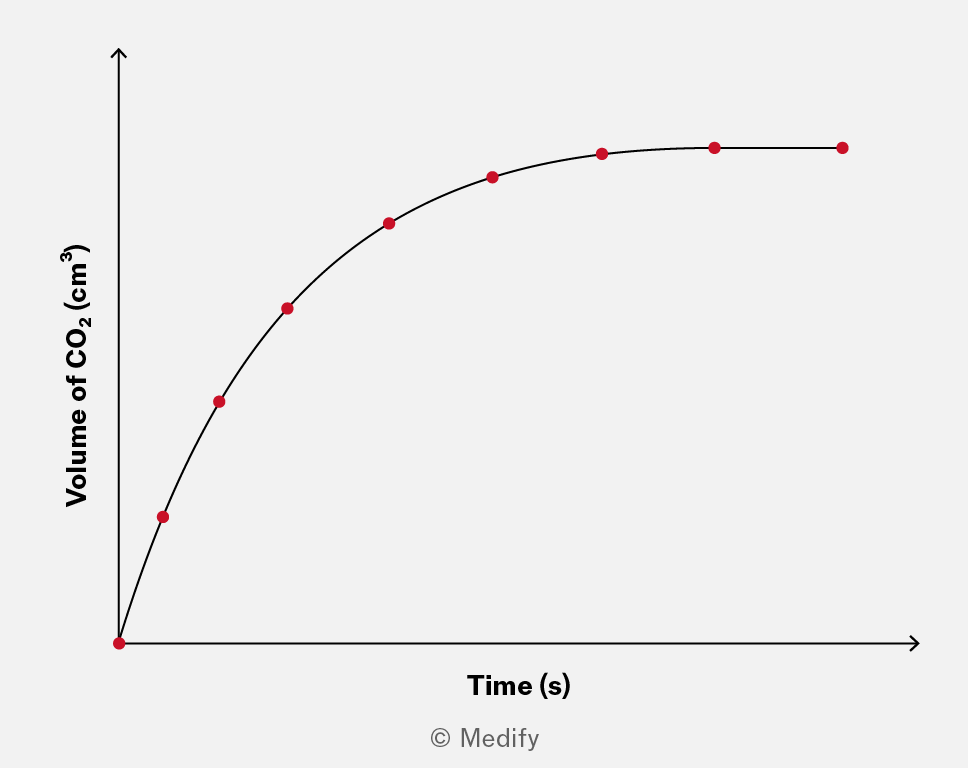
A graph with the x-axis labeled 'Time (s)' and the y-axis labeled 'Volume of CO2 (cm³)'. The graph shows a curve with red markers indicating plotted data points. The curve starts at the origin and rises steeply before leveling off. There are 8 visible markers on the curve. The graph is annotated with © Medify at the bottom.

Compare the reaction order obtained from the two methods.

Add to favourites